3 min read • 15 November 2026


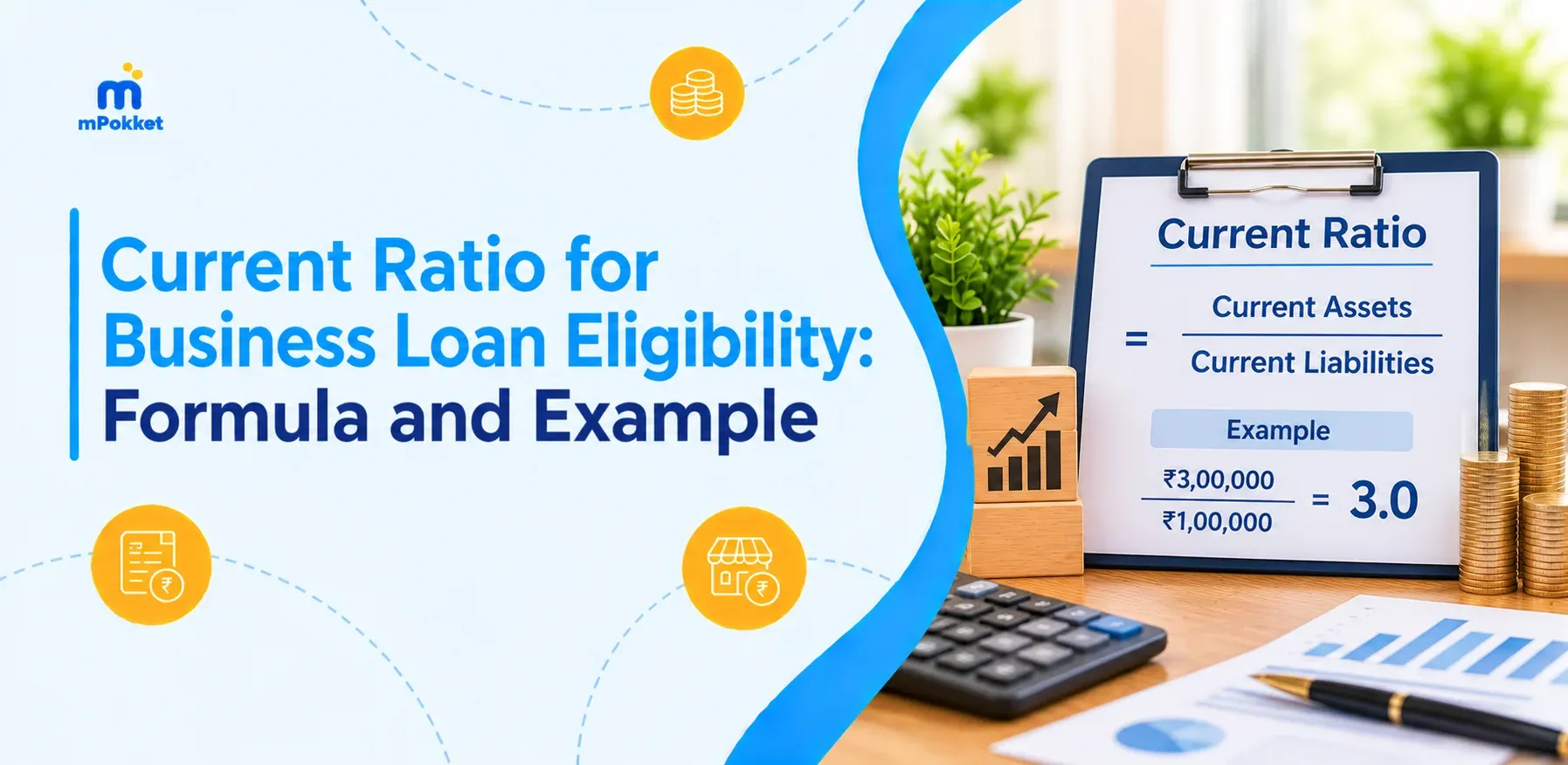
Table of content
Overview
What Is the Current Ratio and Why Is It Important for a Business Loan?
What Is the Current Ratio Formula for a Business Loan Application?
Current Ratio Example: How to Calculate It for a Business Loan?
What Is a Good Current Ratio for Business Loan Eligibility?
How Does the Current Ratio Influence Business Loan Approval?
How to Improve Your Current Ratio Before Applying for a Business Loan?
What Factors Affect My Business Loan Eligibility Most?
Conclusion
Frequently Asked Questions
You have a supplier waiting for payment, a festive-season order to fill, and a business loan application sitting half-done. Then the lender asks for your balance sheet, and the file goes quiet for weeks. Many owners get rejected without ever knowing why. One overlooked number is often behind it: the current ratio.
This guide explains the formula in plain words and walks through a rupee example. It shows what lenders consider healthy, how to fix a weak ratio before you apply, and which other factors shape approval. It also covers how newer digital lenders like mPokket ease the traditional paperwork.
Follow our Whatsapp Community for more offers and updates.
Join nowThe current ratio indicates if your short-term assets are sufficient to meet your short-term liabilities. Lenders use it to judge whether you could afford new repayments comfortably. This is what is on either side:
Simply put, current assets and current liabilities combined give you a sense of your safety in meeting obligations over the next year.
The current ratio formula is current assets ÷ current liabilities, and both numbers come from your balance sheet. A result of 1.5 means you hold ₹1.50 for every ₹1 you owe. The table below breaks it down.
Add up all current assets, add up all current liabilities, then divide one by the other. Take a trading firm with ₹12,00,000 in assets and ₹8,00,000 in liabilities: 12,00,000 ÷ 8,00,000 = 1.5. Here is the full picture.
In this current ratio example, 1.5 looks comfortable. But remove inventory and the quick ratio drops to about 0.88. That is why some lenders check both numbers.
A current ratio between 1.2 and 2 is generally seen as good. Lenders read each range differently, as shown below.
Industry matters too. Retail businesses may function well with ratios as low as 0.90 because their cash inflows are predictable. Some lenders also write a minimum into the agreement. Commercial lenders often require borrowers to stay above 1.2 or 1.5 throughout the loan term.
Keeping a good ratio will help you get approved and can open the door to higher limits. A weak one often means smaller amounts, tougher terms or rejection. The lenders care less about the absolute number than about its stability. In practice it makes four things:
Raise current assets or lower current liabilities, ideally both, three to six months before you apply. Small shifts in collections and short-term debt can lift your ratio noticeably. Start with these three moves.
Boost Cash Flow & Receivables Collection
Send out bills promptly, follow up on late payments and offer a discount for early settlement.You get receivables turned into cash, and you increase your assets, all without taking on any new debt.
Manage Inventory and Current Liabilities
Move slow moving stock out slowly, reorder in smaller batches to free up cash. Agree realistic supplier terms and clear small dues early, to avoid liabilities quietly piling up.
Reduce Short Term Debt & Improve Liquidity
Pay down expensive short-term borrowings or replace short-term debt with long-term debt in an effort to keep the ratio in range. Keep a cash buffer so one slow month doesn’t drag your ratio down.
Lenders will look at your business credit score, cash flow, how old your business is, current debt and liquidity ratios such as the current ratio. No single factor decides the outcome, because they are assessed together.
Traditional lenders often ask for audited balance sheets, long vintage, and collateral. That leaves many small sellers, freelancers, and gig workers out. Digital lenders work differently, and mPokket is one example.
Its app listing says it serves salaried professionals with a minimum salary of ₹9,000, self-employed people, merchants, contract and gig workers, and students with part-time income. Paisabazaar notes that salary slips are not required and that an EMI-to-income ratio below 55% qualifies you. Loans start from ₹500 and everything happens in the app, with no balance sheet or collateral.
That makes small-ticket funds useful for restocking or bridging a cash gap while you improve your ratio. Keep in mind the trade-offs. Amounts are small, and published rates vary widely by source (roughly 22% to 48% p.a., depending on profile and tenure). So confirm current terms in the app and borrow only what you can repay. For larger business financing, banks and NBFCs with formal ratio checks are still the better fit.
Your current ratio is a quick health check that lenders trust. Know the formula, aim for 1.2 or above, and fix weak spots early. Pair it with a healthy credit score and steady cash flow, and your application stands on firmer ground.
Need funds while you build your profile? Download the mPokket app, check your eligibility in minutes, and see the offer that fits you.
1. What is the current ratio formula?
The basic formula is Current ratio = current assets/current liabilities , from your balance sheet .
2. What is the ideal current ratio for a business loan?
Generally 1.2 to 2. The right number will depend on the industry and some lenders will have their own minimum.
3. How do you calculate current assets and current liabilities?
Add all you will receive or pay within 12 months. Assets: cash, accounts receivable, and inventories. Liabilities include payables, short term loans, accrued expenses and taxes payable.
4. Is a current ratio of 1.5 good for business loan eligibility?
Yes. It clears the 1.2 and 1.5 thresholds many lenders use. Credit score and cash flow still matter.
5. Can a business get a loan with a current ratio below 1?
Sometimes it’s harder. You can expect to put up less money, collateral or guarantor. Another way is income-based digital lenders that offer small loans.
6. What is the difference between current ratio and quick ratio?
The quick ratio excludes inventory, so it is a stricter test. In our example, 1.5 becomes about 0.88.
Business Loan Documents Required for MSMEs and Small Businesses
3 min read • 29 July 2026
Business Loan Eligibility: Criteria, Requirements, and Tips for Quick Approval
3 min read • 27 July 2026
Best practices for preparing a small business for digital loan eligibility in India
3 mins min read • 11 November 2026
Mistakes to avoid before submitting business loan documents online in India
4 mins min read • 9 November 2026
