3 min read • 29 July 2026


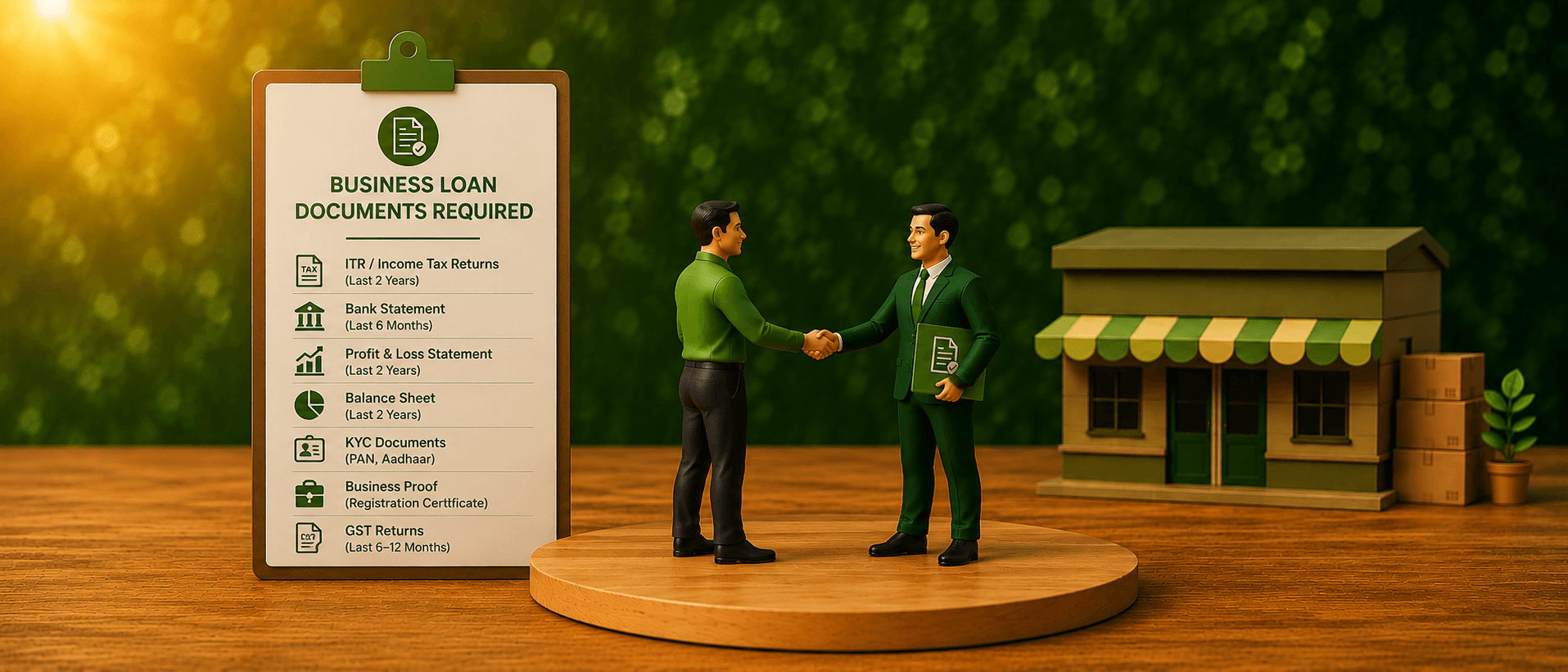
Table of content
A Complete Document Checklist Makes Loan Approval Easier.
Why Your Business Loan Documents Matter for Faster Approval
What Documents Are Required for a Business Loan?
Conclusion
Frequently Asked Questions
Hunting around for the right business loan documents before you apply, and not sure what's actually going to be asked for? Getting this list sorted ahead of time is honestly the single biggest thing that separates a smooth approval from weeks of back-and-forth with a lender.
Every lender, whether it's a bank, an NBFC, or a digital platform, needs some proof of who you are, what your business does, and whether you can realistically repay. Miss one document or submit something outdated, and that alone can stall an otherwise solid application. This piece walks through exactly what MSMEs and small businesses typically need to have ready, how the checklist differs across lender types, and where alternative data now fills gaps that paperwork used to leave open.
Follow our Whatsapp Community for more offers and updates.
Join nowAccurate, complete business loan documents speed up approval because lenders spend less time on manual verification and more time actually assessing your repayment capacity.
Whether it's a mismatched name across your PAN and bank statement or a bank statement that's a few months stale, these small slip-ups are behind a surprising number of delayed or rejected applications. Getting your paperwork right the first time genuinely saves you weeks.
Business loan documents generally fall into three buckets, KYC proof, business proof, and financial documentation, though the exact combination shifts depending on your lender and loan type.
Let's break each category down properly, since the details matter more than the broad strokes.
An MSME business loan usually asks for Udyam registration, GST filings, and a longer financial history compared to a smaller, unsecured loan meant for freelancers or early-stage businesses.
Traditional lenders lean heavily on this full checklist, and honestly, it's exactly the sort of paperwork a lot of newer or smaller businesses simply haven't built up yet. Digital lenders working with alternative credit scoring have changed that equation quite a bit.
mPokket, for instance, evaluates bank transaction patterns and repayment behavior instead of demanding years of GST or ITR history, which opens things up for businesses still early in their journey.
If your MSME registration isn't in place yet, submitting a few months of clean bank statements showing regular business inflow can often work as a reasonable substitute with this kind of lender.
KYC documents confirm your identity and address, and these stay non-negotiable across every lender, bank, or digital app alike.
This part of the checklist rarely changes much between lenders since it's a standard regulatory requirement. Where mPokket differs is in how quickly this gets verified; most of it happens digitally through OTP or a quick document upload, cutting out the in-person verification steps a bank branch often still requires.
Business proof documents establish that your business actually exists and operates the way you say it does, ranging from formal registration certificates to simpler proof like invoices or a shop license.
Smaller businesses, home-based setups, and freelancers often don't have a formal registration certificate lying around, and that's traditionally where applications hit a wall. mPokket's alternative data scoring approach genuinely helps applicants who are running a legitimate operation without the paperwork a big company would have. We accept things like consistent client payment records, invoices, or transaction history as reasonable stand-ins for formal business proof.
A quick pre-application check, verifying document accuracy, updating expired paperwork, and matching personal details across documents, saves real time once you actually submit your application.
Digital lenders that streamline this step, letting you upload everything through an app rather than visiting a branch multiple times, cut down considerably on the back-and-forth that traditional processes usually involve. That said, pre-application readiness matters regardless of which lender you choose; it's not exclusive to any one platform.
Getting your business loan documents in order before you apply is genuinely one of the easiest ways to speed up approval, whether you're going through a bank, an MSME scheme, or a digital lender. Knowing which checklist applies to your business type and where alternative data can fill in gaps saves you from unnecessary rejections and repeated document requests.
If you need funds for your MSME or small business without the usual paperwork hassle, apply for an instant loan with mPokket today, up to ₹2 lakh, even without a perfect CIBIL score or traditional income proof.
1. What is the minimum credit score needed for a small business loan?
Traditional banks generally prefer a score above 700, though many digital lenders don't apply this as a strict cutoff, weighing alternative data like transaction history instead.
2. How to get a business loan without CIBIL?
Digital lenders, assessing alternative data, bank statements, transaction patterns, and repayment behavior, can approve loans even without a strong formal CIBIL history, making this a genuine option for newer businesses.
3. How to check business loan eligibility?
The business loan eligibility criteria sometimes depend on lenders. You can find them on their website or app. Moreover, you enter basic details like income, business type, and loan amount in the loan eligibility checker to get an instant estimate before formally applying.
4. Is a business loan interest-free?
No, business loans carry interest, typically ranging from 11% to 24% per annum depending on the lender, loan type, and your credit profile, though some government schemes offer subsidized rates.
5. Do we have to pay tax on a business loan?
The loan amount itself isn't treated as taxable income since it's borrowed money, not earnings. However, the interest paid on a business loan is generally allowed as a deductible business expense, reducing your taxable profit.
Working Capital Loan: Everything Small Businesses Should Know
5 min read • 17 July 2026
7 Smart Reasons to Consider a Business Loan for Growth
4 min read • 21 July 2026
How Can Self-Employed Professionals Use a 2 Lakh Loan for Business Needs?
3 min read • 6 February 2026