4 mins min read • 27 November 2026


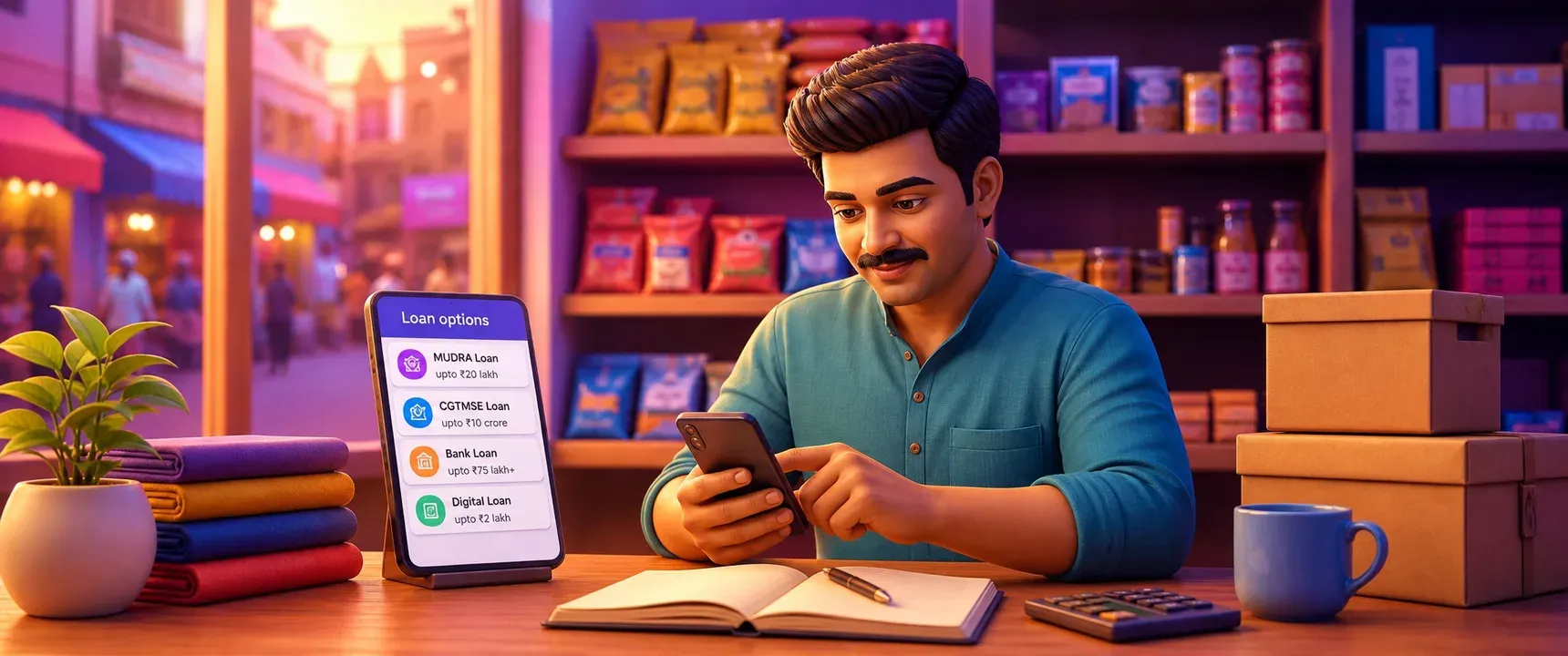
Table of content
Summary
What is a business loan?
Types of small business loans
Comparison by use case
Criteria for choosing a lender
Scoring matrix
When mPokket fits best
Documents typically needed
How to improve approval odds
FAQs
A shopkeeper in Pune needs ₹1.5 lakh to restock before the festive rush. A trader in Jaipur wants ₹8 lakh for a bulk purchase. A home baker in Chennai is looking for ₹40,000 to buy an oven. Each of these business owners needs a different kind of small business loan, and the Indian lending market now offers more options than ever. This guide from mPokket breaks down the best small business loan options in India by use case, so you can match your actual need to the right product.
Follow our Whatsapp Community for more offers and updates.
Join nowA business loan is a sum borrowed specifically to fund commercial operations. It can cover inventory purchases, vendor payments, equipment, salaries, rent, or expansion costs. In India, business loans are offered by public sector banks, private banks, NBFCs, and digital lending platforms.
The key distinction from a personal loan is purpose. Business loans are underwritten based on business performance, turnover, and trade activity rather than just personal salary. Some products, especially from digital lenders, blur this line by using alternative data to assess repayment capacity.
Indian small business owners can access several distinct loan structures. Each serves a different stage of business growth and a different funding need. Understanding the categories helps you avoid applying for the wrong product.
The Pradhan Mantri Mudra Yojana (PMMY) is the most accessible government loan for micro enterprises. It offers collateral free credit across four categories: Shishu (up to ₹50,000), Kishor (₹50,001 to ₹5 lakh), Tarun (₹5 lakh to ₹10 lakh), and the newer Tarun Plus (₹10 lakh to ₹20 lakh). Tarun Plus was introduced in the Union Budget 2024 and is available only to borrowers who have successfully repaid a previous Tarun loan.
The CGTMSE scheme provides a government backed credit guarantee that allows banks to lend without collateral. The guarantee cover was doubled from ₹5 crore to ₹10 crore effective April 2025, with coverage typically ranging from 75% to 85% of the sanctioned amount. Women entrepreneurs can receive up to 90% guarantee coverage under this scheme.
Public and private sector banks offer unsecured business loans typically ranging from ₹1 lakh to ₹75 lakh. Processing can take 7 to 15 business days, and eligibility usually requires a strong credit profile, business vintage of two or more years, and formal financial documentation such as ITR filings and GST returns.
Non banking financial companies offer both secured and unsecured business loans. They tend to accept a wider range of borrower profiles than banks but charge higher interest rates. Loan amounts and tenures vary significantly across NBFCs.
Digital lenders operate entirely through apps and online platforms. They prioritize speed and minimal documentation. mPokket falls in this category, offering collateral free business loans up to ₹2 lakh through a paperless process that uses Aadhaar and PAN based KYC. Approval can happen in minutes rather than days.
The right loan depends on what you need the money for, how fast you need it, and what documentation you can provide. The table below maps common small business needs to the loan type that fits best.
| Use case | Best loan type | Typical amount | Speed | Collateral |
|---|---|---|---|---|
| Inventory restocking before a season | Digital lender (e.g. mPokket) or MUDRA Shishu/Kishor | ₹10,000 to ₹5 lakh | Same day (digital) or 1 to 3 weeks (MUDRA) | None |
| Vendor payments and salary payouts | Working capital loan (digital or NBFC) | ₹50,000 to ₹5 lakh | 1 to 5 days | Usually none |
| Equipment purchase or shop renovation | MUDRA Tarun or bank term loan | ₹5 lakh to ₹25 lakh | 2 to 4 weeks | None (MUDRA) or may be required (bank) |
| Business expansion or new branch | CGTMSE backed bank loan or NBFC | ₹10 lakh to ₹1 crore+ | 3 to 6 weeks | None under CGTMSE |
| Short term cash flow gap | Digital lender (e.g. mPokket) | ₹10,000 to ₹2 lakh | Same day | None |
| Startup runway for new business | MUDRA Kishor/Tarun or Stand Up India | ₹50,000 to ₹10 lakh | 2 to 6 weeks | None or partial guarantee |
Comparing small business loans requires looking beyond just the interest rate. Here are the five dimensions that matter most for Indian MSMEs and micro enterprises.
Many small business owners do not have property or assets to pledge. Government schemes like MUDRA and CGTMSE eliminate this barrier entirely. Digital lenders like mPokket also offer unsecured loans, assessed on business activity and alternative data rather than asset ownership.
Bank loans can take two to six weeks from application to disbursal. Government scheme processing depends on the bank branch handling the application. Digital platforms can process and disburse within hours. If your need is urgent, such as a bulk purchase window or an overdue vendor payment, speed becomes the deciding factor.
Traditional lenders require ITR filings, GST returns, audited financial statements, and business registration documents. mPokket's process is designed to be paperless, using Aadhaar and PAN based digital KYC and alternative data assessment. This makes it accessible to businesses that lack formal financial documentation.
Fixed EMI structures work for businesses with predictable monthly revenue. Businesses with irregular cash flow, such as seasonal traders or project based service providers, benefit from flexible repayment options. mPokket offers manageable EMI structures and does not charge foreclosure fees, which helps borrowers who can repay early.
Banks typically require a minimum business vintage of two years, a CIBIL score above 700, and documented turnover. MUDRA loans have simpler eligibility but still require a project report for larger categories. mPokket uses alternative data assessment and does not impose a rigid CIBIL score barrier, making it suitable for first time borrowers and businesses without a formal credit history.
The matrix below scores three broad lender categories across the five criteria that matter most to small business borrowers. Scores reflect general market patterns rather than specific lender guarantees.
| Criterion | Government schemes (MUDRA, CGTMSE) | Banks and NBFCs | Digital lenders (e.g. mPokket) |
|---|---|---|---|
| No collateral needed | Yes (fully collateral free) | Varies (often required for larger amounts) | Yes (fully collateral free) |
| Approval speed | Moderate (1 to 6 weeks) | Slow to moderate (1 to 6 weeks) | Fast (minutes to hours) |
| Documentation simplicity | Moderate (project report needed for Kishor and above) | Heavy (ITR, GST, financials) | Minimal (Aadhaar, PAN, basic business proof) |
| Repayment flexibility | Standard EMI | Standard EMI, some offer flexi options | EMI with no foreclosure charges |
| First time borrower access | Good (designed for micro units) | Limited (credit history usually required) | Strong (alternative data assessment) |
mPokket is designed for a specific segment of the small business lending market. It serves shopkeepers, traders, small retailers, and micro entrepreneurs who need working capital quickly and cannot navigate the documentation requirements of traditional lenders.
The platform offers collateral free business loans up to ₹2 lakh. The entire process runs through the mPokket app, from KYC registration to loan disbursal directly into the borrower's bank account. There is no branch visit required. mPokket assesses applications using alternative data and business performance indicators rather than demanding a high CIBIL score or ITR filings.
This makes mPokket particularly relevant for inventory restocking, vendor payments, salary payouts, equipment purchases, and bridging short term cash flow gaps. If your business needs a larger amount, say ₹10 lakh or more, a MUDRA Tarun loan or a CGTMSE backed bank loan would be more appropriate. mPokket fills the gap for smaller, faster, documentation light funding needs.
Documentation requirements vary significantly across lender types. Here is what to expect for each channel.
For MUDRA loans, you typically need an Aadhaar card, PAN card, business registration or Udyam certificate, a project report (for Kishor and above), and bank statements. For bank and NBFC business loans, expect to provide ITR filings for two to three years, GST returns, audited financial statements, business registration, KYC documents, and sometimes property documents for secured loans.
For mPokket, the documentation is minimal. The app based process requires Aadhaar and PAN for digital KYC, basic business proof, and bank account details. Income proof requirements are flexible, and the platform accepts alternative data as part of its assessment.
Regardless of which lender you choose, a few steps can strengthen your application. Register your business under Udyam (MSME registration) because it unlocks access to government schemes and signals legitimacy to all lenders. Maintain clean bank account activity with regular deposits and withdrawals. If you have existing loans, ensure on time repayment to build a positive credit trail.
For first time borrowers, starting with a smaller loan and repaying it on time is the most practical way to build credit history. Platforms like mPokket that do not require a prior credit score can serve as a first step into formal borrowing.
Small business lending in India has moved well beyond the traditional bank branch model. Government schemes provide low cost, collateral free options for patient borrowers. Digital lenders like mPokket fill the speed and accessibility gap for micro enterprises that need funds now. The best loan is the one that matches your specific use case, documentation capacity, and urgency. Compare on those dimensions rather than chasing the lowest advertised rate.
The best small business loan depends on your use case. Government schemes like MUDRA and CGTMSE backed loans suit micro and small enterprises needing collateral free credit. Digital lenders like mPokket can help when you need fast, paperless access to smaller amounts up to ₹2 lakh for working capital or inventory.
A business loan is financing specifically for commercial operations such as inventory, vendor payments, equipment, or expansion. Unlike personal loans, business loans are assessed based on business performance, turnover, and trade activity. They are available from banks, NBFCs, government schemes, and digital platforms like mPokket.
Yes. MUDRA loans (up to ₹20 lakh under Tarun Plus), CGTMSE backed bank loans (guarantee cover up to ₹10 crore), and digital lenders like mPokket all offer collateral free options. Eligibility depends on your business profile, vintage, and the lender's assessment criteria.
Eligibility varies by lender. MUDRA loans are open to non corporate, non farm micro enterprises. Banks typically require two or more years of business vintage and a strong credit score. mPokket uses alternative data assessment and is designed to be accessible to first time borrowers, self employed professionals, and micro business owners.
Digital lenders like mPokket can process and disburse loans within hours through a fully app based process. Bank loans typically take one to six weeks. Government scheme processing depends on the branch and can range from one to six weeks as well.
The Complete Guide to Collateral-Free Business Loans
3 min read • 29 July 2026
Know the Different Types of Business Loans
4 min read • 28 July 2026
How mPokket serves borrowers with limited or no prior credit history
3 mins min read • 20 September 2026
Working Capital Loan: Everything Small Businesses Should Know
5 min read • 17 July 2026
Does Udyam Registration Improve MSME Loan Eligibility?
2 min read • 10 September 2026