3 min read • 29 November 2026


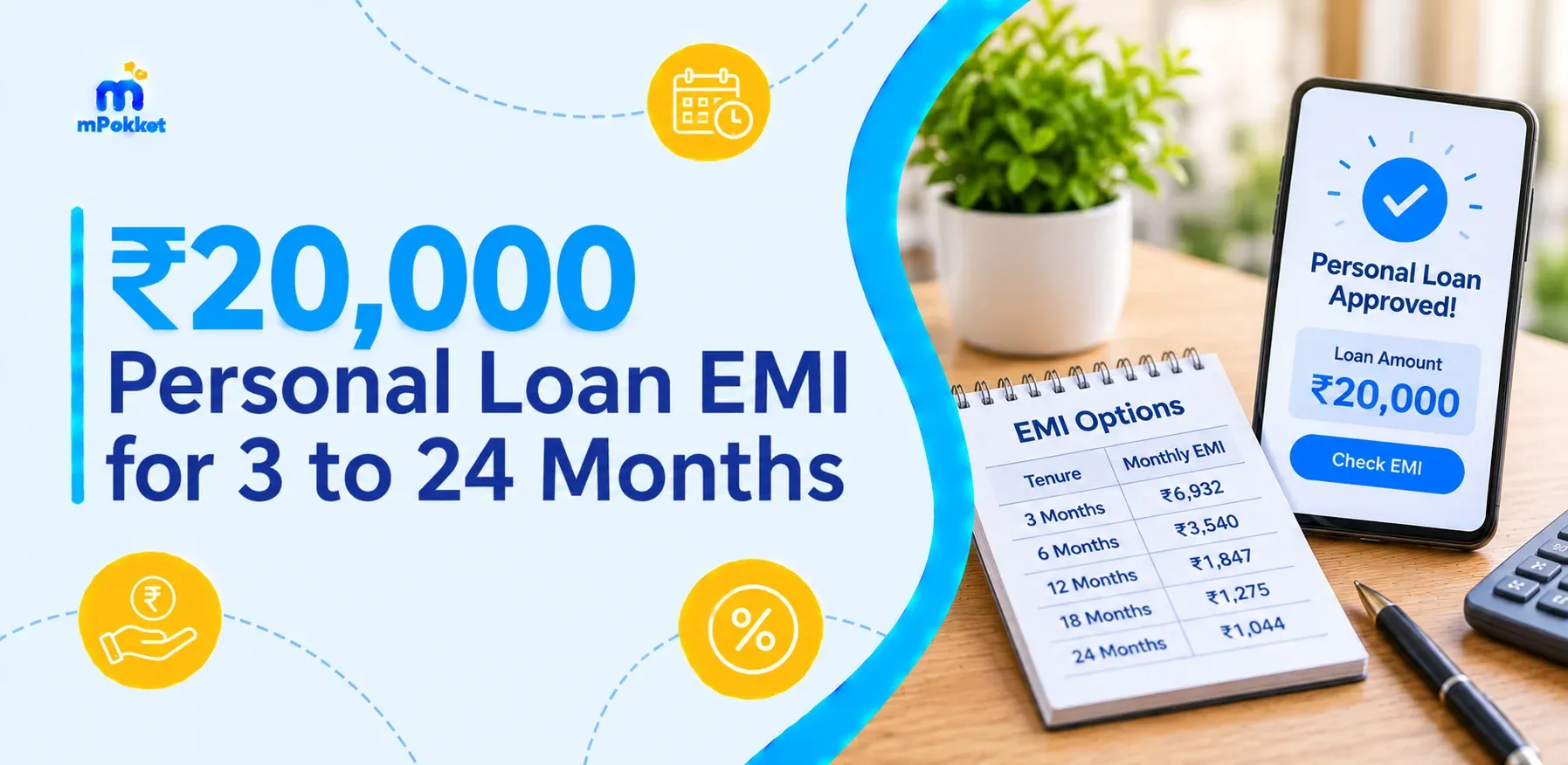
Table of content
Overview
How Is the EMI on a ₹20,000 Loan Calculated?
What Does the ₹20,000 Personal Loan EMI Table Look Like?
Is Total Interest Lower on a Short or Long Tenure for a Loan on ₹20,000?
What Fees Reduce the Amount Credited on an Instant ₹20,000 Loan?
How Do I Choose a ₹20,000 Personal Loan EMI Tenure I Can Afford?
How Do I Calculate Personal Loan Interest Manually, Step by Step?
How Does mPokket Make a Loan on ₹20,000 Easier to Get?
Conclusion
Frequently Asked Questions
A ₹20,000 personal loan EMI is the fixed amount you pay every month to repay ₹20,000 plus interest over an agreed tenure. A longer tenure lowers the EMI but raises the total interest.
You need ₹20,000 this week. Maybe it’s a medical bill, a rent gap or a broken laptop. Then the questions start. How much will the EMI be? Will the money that lands in your account actually be ₹20,000? Is a longer tenure really cheaper?
Most apps show you a big number and leave the maths to you. This guide fixes that. At 24% p.a., the ₹20,000 personal loan EMI works out to about ₹6,935 for 3 months and ₹1,057 for 24 months. You’ll see the full table, the interest you pay, the fees that shrink your payout, and how to calculate it all yourself. By the end, you can pick an EMI that fits your month without any nasty surprises.
Follow our Whatsapp Community for more offers and updates.
Join nowEMI depends on three things: the loan amount, the interest rate and the tenure. Plug them into the standard formula, or use a personal EMI calculator to get the answer in seconds.
Here’s what each input does:
What is the EMI formula?
EMI = P × r × (1 + r)ⁿ ÷ [(1 + r)ⁿ − 1]. P is the principal (₹20,000), r is the monthly rate (annual rate ÷ 12 ÷ 100), and n is the number of months.
Why does the interest rate matter so much?
A few percentage points move the total noticeably. On a 12-month loan, 18% costs about ₹2,003 in interest, while 30% costs about ₹3,397.
Can a personal EMI calculator replace the formula?
Yes. A personal EMI calculator does the same maths instantly. It’s handy for testing tenures before you accept an offer.
At 24% p.a. on a reducing balance, your EMI ranges from roughly ₹6,935 (3 months) to ₹1,057 (24 months). Use the table below to calculate loan EMI at a glance.
Figures are rounded, reducing-balance estimates at 24% p.a. and exclude fees and GST. Your actual rate may differ.
How much would a different rate change things? Here’s the 12-month comparison:
Shorter is cheaper in total interest. Stretching a loan on ₹20,000 from 6 to 24 months at 24% raises your interest from ₹1,423 to ₹5,378, nearly four times as much.
Here’s the trade-off in plain terms:
Is a shorter tenure always the better choice?
Not always. If a ₹6,935 EMI would strain your budget and make you miss a payment, the late fees and credit score damage can cost more than the extra interest.
Processing fees and GST are usually deducted upfront, so you receive less than ₹20,000 while EMIs are still calculated on the full amount. Always check the net payout before accepting an instant ₹20,000 loan.
Typical charges to look for:
For example, a 4% fee is ₹800, plus ₹144 GST. You’d get ₹19,056 but repay on ₹20,000. With a flat fee of ₹200 plus GST, you’d receive about ₹19,764.
How can I see the real cost?
Ask for the Key Fact Statement. Under RBI rules, lenders must show the APR, which rolls interest and fees into one yearly figure you can compare.
Keep your total EMIs under about 40% of monthly income. Pick the shortest tenure that stays inside that limit, because that gives you the lowest total interest.
Try this simple check:
Step 1: List your fixed outgo
Add rent, bills, groceries and existing EMIs. Whatever remains is your real repayment room.
Step 2: Match it to the table
Find the tenure whose EMI sits comfortably below that leftover amount, with some buffer for surprises.
Step 3: Consider your income pattern
Gig workers and freelancers with uneven earnings may prefer a slightly longer tenure, then prepay when a good month arrives.
Divide the annual rate by 12, apply it to the outstanding balance each month, and subtract the principal portion from the EMI. Here’s a worked example for 12 months at 24%.
Early EMIs are interest-heavy, and the principal share grows over time. Some apps use a flat rate instead, charged on the original ₹20,000 throughout. That looks cheaper but costs more in real terms, so always compare using APR.
mPokket is a digital lending app built for people that traditional lenders often skip, such as students, young professionals, gig workers and the self-employed. It offers small-ticket personal loans for urgent needs.
Banks usually expect a high credit score, a steady salary slip and years of work history. That’s tough for a fresher or a freelancer. mPokket eases this in a few ways:
Rates, fees, limits and tenures vary by profile and can change, so confirm the figures shown before you accept. Treat any app, including this one, as a short-term tool, not a long-term habit.
The ₹20,000 personal loan EMI isn’t a mystery number. It’s the result of amount, rate and tenure. Shorter tenures save interest, longer ones ease your monthly pressure, and fees decide what actually reaches your account. Run your own numbers in a personal EMI calculator, read the Key Fact Statement, and choose the tenure you can repay without stress.
At 24% p.a., the EMI is about ₹1,891, with total interest of roughly ₹2,694. At 18% it’s about ₹1,834, and at 30% about ₹1,950.
It’s cheaper in interest, yes. But if the higher EMI risks a missed payment, penalties can erase the savings. Choose the shortest tenure you can pay comfortably.
It depends on the fee. A 4% fee plus GST leaves about ₹19,056, while a ₹200 fee plus GST leaves about ₹19,764. Check the net disbursal before accepting.
Usually yes, and it cuts your interest. Some lenders charge a prepayment fee, so check the terms first. Part-payments after a good income month work well.
A Complete Guide to Getting a Personal Loan Up to ₹20,000 Online
4 min read • 12 August 2026
An EMI fit worksheet for borrowers deciding loan amount tenure and repayment comfort in India
4 mins min read • 17 November 2026
A repayment channel scorecard for UPI, autopay, and manual loan repayment
4 mins min read • 5 November 2026
Best practices for reducing EMI stress before it becomes a repayment problem
4 mins min read • 17 November 2026