4 mins min read • 24 November 2026


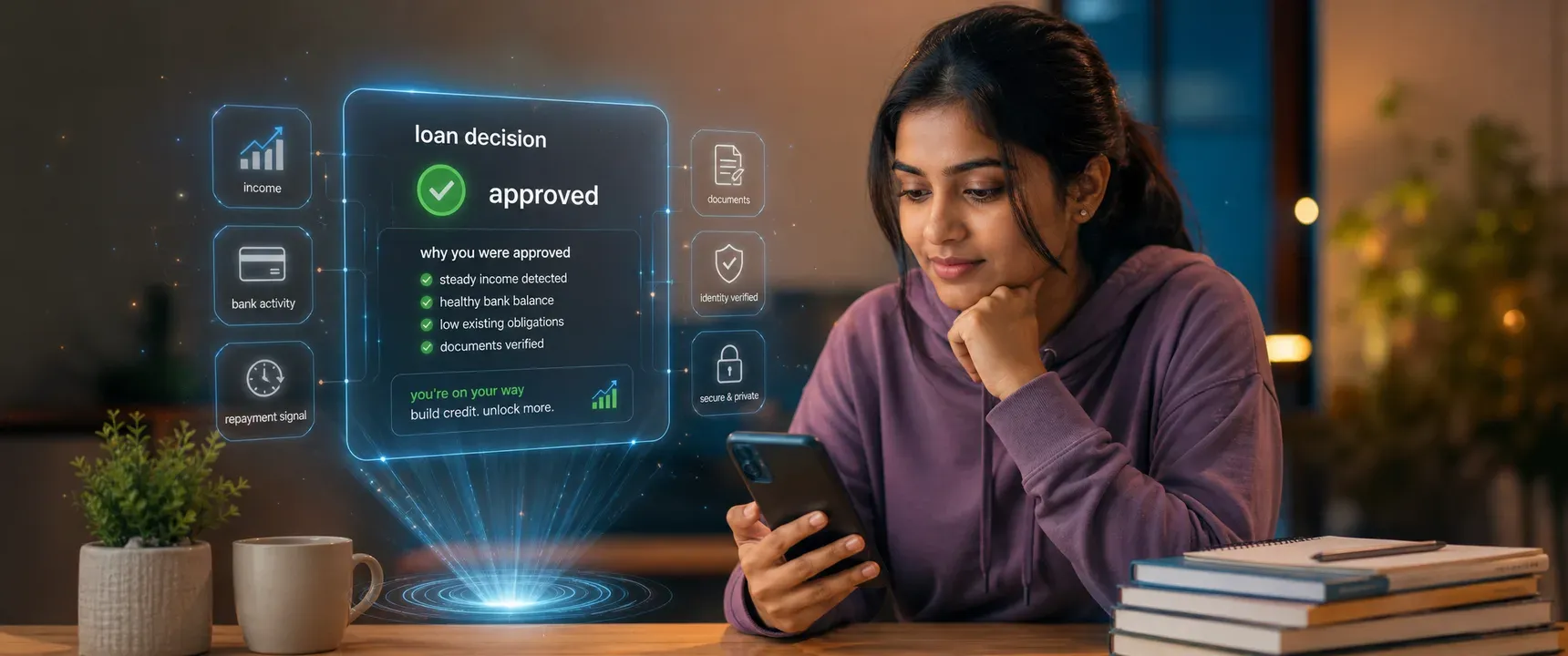
Table of content
Overview
Who are thin file borrowers?
Why binary outcomes erode trust
What explainable underwriting looks like
Credit access as communication
Alternative assessment needs transparency
Regulatory alignment matters
Building trust with excluded applicants
FAQs
A college student in Pune applies for a small personal loan. The app processes her data, runs its checks, and returns a single word: rejected. No context. No explanation. No path forward. She closes the app wondering whether she did something wrong or whether the system simply cannot see her. For millions of thin file borrowers across India, this silence is the real barrier to credit. mPokket believes that underwriting should communicate, not just calculate.
Follow our Whatsapp Community for more offers and updates.
Join nowIndia has hundreds of millions of adults who have never borrowed from a formal institution. Bureau data on them is sparse or nonexistent. Traditional credit scores rely on repayment history from banks, credit cards, and registered NBFCs.
When that history is missing, the borrower is labeled "thin file." The term covers a wide range of people. Freshers entering their first job, interns living on stipends, housewives managing household budgets, freelancers with project based income, and gig workers driving cabs or delivering food all fall into this category.
These individuals are not necessarily risky. They are simply invisible to conventional scoring models. A fresher who has managed a monthly stipend responsibly for two years has demonstrated discipline, but no bureau file captures that behavior.
Most digital lending platforms today return a result without reasoning. The applicant sees "approved" or "rejected" and nothing else. For someone with a dense credit file, this may feel routine. For a thin file borrower, it can feel arbitrary.
Consider a housewife applying for a small loan to fund a home based tiffin business. She submits her Aadhaar, PAN, and bank statements. The app declines her. She does not know whether the issue was her income level, her lack of prior loans, or a document she uploaded incorrectly. She has no way to improve her chances next time.
This opacity creates a cycle. Borrowers who are declined without explanation often stop trying. They retreat to informal credit sources, which offer no path to building a formal credit profile. The lender, meanwhile, loses a potential long term customer.
Binary outcomes also raise fairness concerns. When algorithms trained on alternative data make decisions without disclosure, borrowers cannot verify whether the process treated them equitably. The RBI's digital lending guidelines (RBI, 2022) require lenders to provide a Key Fact Statement and follow fair practice codes. Transparent underwriting aligns with the spirit of these requirements.
Explainable underwriting does not mean revealing proprietary algorithms. It means communicating the categories of information that influenced a decision. A lender can tell a borrower, for example, that the decision considered income consistency, existing obligations, and document completeness without exposing exact model weights.
mPokket's approach to digital lending for first time borrowers and thin file applicants reflects this philosophy. By using alternative data assessment, including bank account activity, income patterns, and digital KYC signals, mPokket is designed to evaluate applicants who lack traditional credit scores. The key difference is that this assessment can be paired with clear communication about what the borrower can do to strengthen their profile.
Explainable decisions serve several purposes. They help the borrower understand the outcome. They give the borrower actionable next steps. They demonstrate that the lender followed a structured, fair process. And they create a foundation for the borrower to return, better prepared, for a future application.
The lending industry in India often frames financial inclusion as a distribution problem. Build more apps, reach more pin codes, process more applications. That framing is incomplete. Access without understanding is not genuine inclusion.
A first time borrower who receives a loan without understanding the terms, the repayment schedule, or the consequences of a missed EMI is not truly included. Similarly, a borrower who is declined without context is not truly served. Both scenarios treat the borrower as a data point rather than a person navigating an unfamiliar system.
mPokket's position is that digital lending should treat communication as a core product feature, not an afterthought. When a loan app explains why a decision was made, it shifts the relationship from transactional to educational. The borrower learns something about their own financial profile. That knowledge compounds over time.
For thin file borrowers specifically, this matters because their first interaction with formal credit shapes their long term behavior. A positive, transparent experience can help them build credit history early, repay responsibly, and eventually qualify for larger financial products. A negative, opaque experience can push them away from formal finance entirely.
Alternative data assessment is growing across India's digital lending ecosystem. Lenders increasingly look at bank statement patterns, UPI transaction frequency, employment signals, and device metadata to evaluate applicants who lack bureau scores.
This approach can help expand access. But it also introduces new risks. When a borrower does not know which data points are being evaluated, they cannot consent meaningfully. They cannot correct inaccuracies. They cannot understand why two seemingly similar applicants received different outcomes.
Transparency in alternative assessment does not require full algorithmic disclosure. It requires category level explanation. A lender can say: "We reviewed your bank account activity over the past six months and found inconsistent deposits." That single sentence gives the borrower more agency than a silent rejection ever could.
mPokket's digital lending platform uses alternative data to assess thin file borrowers, including students, freshers, and self employed individuals. By pairing this assessment with clear, borrower facing communication, mPokket is designed to help applicants understand their standing and take concrete steps toward approval.
The RBI's digital lending guidelines issued in 2022 established several borrower protection requirements. These include mandatory disclosure of all fees and charges, provision of a Key Fact Statement before loan execution, and adherence to fair practice codes that prohibit arbitrary lending decisions.
While these guidelines do not explicitly mandate decision explanations for declined applications, the underlying principle is clear: borrowers deserve to understand the terms and logic of their financial interactions. Lenders who go beyond minimum compliance by explaining underwriting decisions position themselves as more trustworthy and more aligned with regulatory intent.
For mPokket, this alignment is strategic. As a loan app serving first time borrowers, freshers, and individuals seeking a loan without credit score, demonstrating transparent practices can help build long term brand authority. It signals to regulators, borrowers, and the broader market that the platform prioritizes fairness alongside speed.
Trust is the scarcest resource in digital lending for thin file borrowers. These applicants often approach loan apps with anxiety. They worry about hidden charges, data misuse, and unexplained rejections. Every interaction either builds or erodes that fragile trust.
Explainable underwriting addresses this directly. When a borrower understands why they were approved, they feel confident about the terms. When they understand why they were declined, they feel respected rather than dismissed. Both outcomes strengthen the relationship between borrower and lender.
mPokket's focus on serving students, interns, housewives, gig workers, and other thin file segments means that trust building is not optional. It is the foundation of the business model. A fresher who has a positive, transparent experience with mPokket during their first loan is more likely to return as a salaried professional seeking larger credit products later.
This long term view distinguishes thoughtful digital lenders from those that optimize only for instant approval volume. The market rewards speed, but sustainable growth requires trust. And trust begins with explanation.
Thin file borrowers in India are not asking for guaranteed approvals. They are asking to be seen, heard, and treated fairly. mPokket's commitment to explainable, transparent underwriting is designed to meet that expectation, turning credit decisions into conversations rather than verdicts.
mPokket is designed to assess applicants who lack a traditional credit score by using alternative data such as bank account activity and digital KYC. This approach can help first time borrowers, freshers, and thin file applicants access credit through a paperless, online process.
Yes, several digital lenders including mPokket evaluate borrowers using alternative assessment methods rather than relying solely on bureau credit history. Applicants with no prior loans can potentially qualify based on income patterns, bank statements, and identity verification.
Explainable underwriting means the lender communicates the categories of factors that influenced a lending decision. Instead of a bare approval or rejection, the borrower receives context about what shaped the outcome, helping them understand their financial standing.
mPokket uses alternative data assessment, including bank account activity, income consistency signals, and digital KYC through Aadhaar and PAN verification. This approach is designed to evaluate applicants who lack dense credit bureau files.
Transparency helps borrowers understand lending decisions, correct errors, and build stronger financial profiles over time. It also aligns with RBI digital lending guidelines (RBI, 2022) that emphasize fair practices and borrower protection in online lending.
Which app gives loan without credit score in India
3 mins min read • 18 September 2026
Digital lenders should stop treating borrowers with thin files as second class customers
3 mins min read • 7 October 2026
How First-Time Borrowers Can Build Credit History in India (Step-by-Step Guide)
5 min read • 6 May 2026
The growing role of alternative borrower signals in India's digital credit market
3 mins min read • 20 September 2026