4 mins min read • 20 October 2026


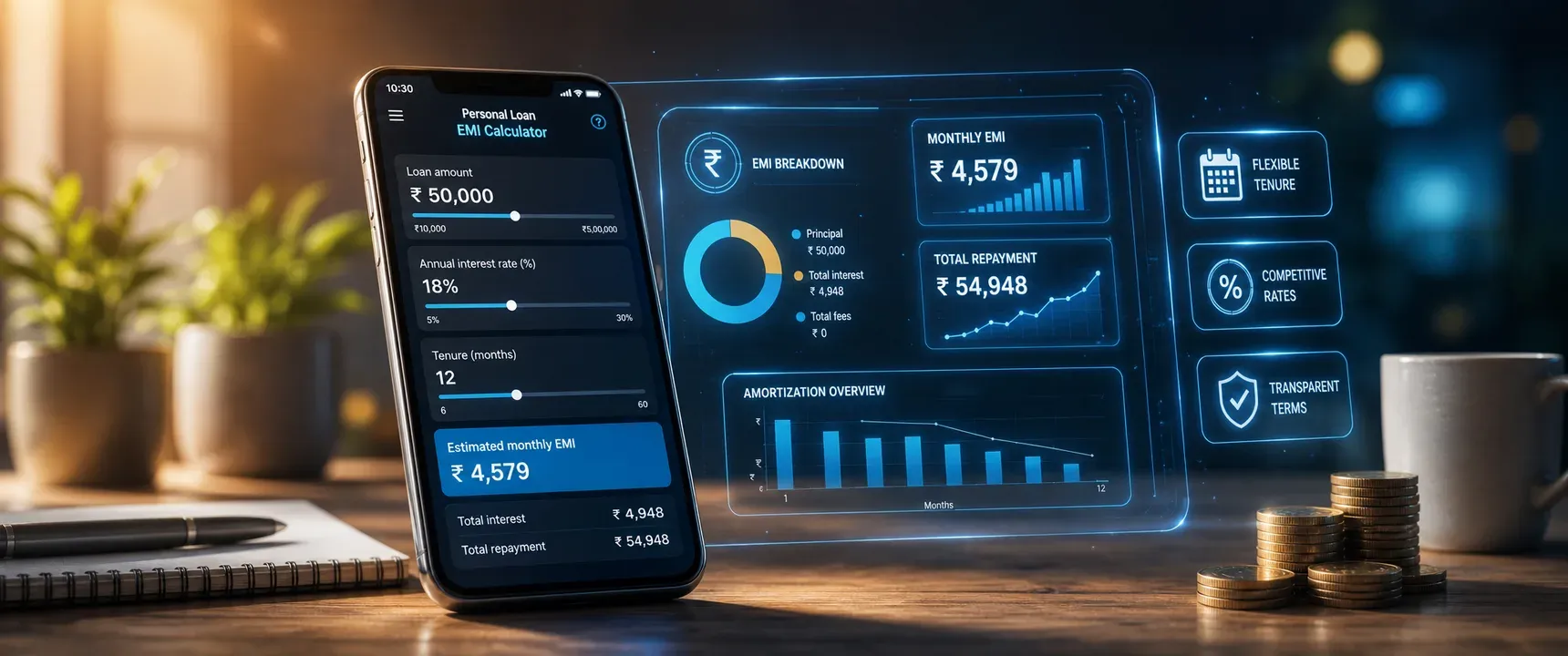
Table of content
How EMI calculators became essential in India's digital loan journeys
Why EMI calculators went mainstream
How to calculate personal loan EMI online
A simple example in rupees
Key variables that shape your EMI
EMI calculators in the digital loan journey
Who benefits most from pre-application EMI checks
Practical tips for using an EMI calculator
Transparency and responsible borrowing
FAQs
Before applying for a personal loan, most borrowers in India now ask the same question: can I actually afford the monthly payment? That single concern has turned the personal loan EMI calculator from a niche fintech feature into a mainstream step in every digital loan journey. Platforms like mPokket place EMI estimation at the center of the borrowing experience, reinforcing transparent terms and helping users plan repayment before a single rupee is disbursed.
Follow our Whatsapp Community for more offers and updates.
Join nowA decade ago, most personal loan applicants in India discovered their EMI only after paperwork was complete. Branch visits, opaque fee structures, and delayed disclosures meant borrowers often committed without a clear picture of monthly outflows.
Digital lending changed that sequence. As loan apps and online platforms grew, borrowers gained access to self-service EMI calculators before even submitting an application. The shift was not cosmetic. It moved affordability assessment from the lender's back office to the borrower's phone screen.
RBI's push for transparency, including the Key Fact Statement requirement, reinforced this trend. Lenders are now expected to present all cost components clearly. An EMI calculator is the simplest way for a borrower to verify those numbers independently.
Platforms like mPokket embed EMI estimation into the pre-application flow. This means a salaried employee, a fresher, or a self-employed professional can test different loan amounts and tenures before deciding whether to proceed. The result is fewer surprises and more disciplined borrowing.
The standard EMI formula uses three inputs: principal amount (P), annual interest rate (R), and tenure in months (N). The mathematical expression is EMI = P x R x (1+R)^N / ((1+R)^N minus 1), where R is the monthly interest rate (annual rate divided by 12 and then by 100).
Most borrowers never need to compute this manually. An online personal loan EMI calculator does the work instantly. You enter the three values, and the tool returns your estimated monthly instalment, total interest payable, and total repayment amount.
Suppose you consider borrowing Rs 50,000 at an annual interest rate of 18% for 12 months. The monthly rate is 1.5%. Plugging these into the formula, the estimated EMI comes to approximately Rs 4,579. Over 12 months, total interest is roughly Rs 4,948, and total repayment is about Rs 54,948.
Now change the tenure to 6 months. The EMI rises to approximately Rs 8,768, but total interest drops to around Rs 2,608. This comparison is exactly why EMI calculators matter: they let you see the trade-off between lower monthly payments and higher total cost.
| Variable | Effect on monthly EMI | Effect on total interest | What to consider |
|---|---|---|---|
| Loan amount (principal) | Higher principal raises EMI proportionally | Higher principal increases total interest | Borrow only what you need; avoid rounding up |
| Interest rate | Higher rate increases EMI | Higher rate significantly raises total cost | Compare rates across lenders; check if rate is flat or reducing |
| Tenure (months) | Longer tenure lowers monthly EMI | Longer tenure increases total interest paid | Balance affordability with total cost; use calculator to test options |
| Repayment type | Reducing balance lowers EMI over time | Reducing balance costs less than flat rate | Confirm which method your lender uses |
Among these, tenure has the most dramatic visible effect on monthly EMI. Doubling the tenure can nearly halve the instalment, but it also stretches interest payments. Borrowers should experiment with all three sliders in the calculator before settling on a combination.
In a typical digital lending flow, the EMI calculator sits between initial interest and formal application. Here is how it fits into the broader journey for platforms like mPokket.
First, the borrower explores loan options and checks eligibility. Next, they open the EMI calculator, enter a tentative loan amount, and adjust tenure until the monthly payment fits their budget. Only then do they proceed to submit documents and complete KYC.
This sequence matters because it puts the borrower in control. Instead of reacting to a lender's offer, the user arrives at the application stage already knowing what repayment looks like. mPokket is designed to support this approach by offering transparent loan terms and visible repayment schedules before disbursal.
Salaried employees can match EMI to their pay cycle. Freshers and interns with limited income can verify that a small loan will not strain their monthly stipend. Self-employed professionals with variable cash flow can test shorter tenures to minimize interest. Housewives exploring small loans for home ventures can confirm that repayment fits household budgets.
In each case, the calculator acts as a financial planning checkpoint. It does not guarantee approval, but it helps the borrower avoid applying for an amount they cannot comfortably repay.
Start with your actual monthly surplus, not the maximum loan you qualify for. If your take-home pay is Rs 25,000 and fixed expenses consume Rs 18,000, your comfortable EMI ceiling is well below Rs 7,000. Work backward from that number.
Always check whether the interest rate displayed is flat or reducing (diminishing balance). A flat rate of 15% costs significantly more than a reducing rate of 15% over the same tenure. Most digital lenders, including mPokket, use the reducing balance method, which is more borrower-friendly.
Run at least three scenarios: your ideal loan amount at the shortest tenure you can afford, the same amount at a moderate tenure, and a slightly lower amount at the shortest tenure. Comparing these three gives you a realistic range of monthly commitments.
Finally, factor in other obligations. If you already have an active EMI or recurring expense, subtract that from your surplus before deciding. Responsible borrowing means your total EMI burden stays within a manageable share of your income.
The mainstreaming of EMI calculators reflects a broader cultural shift in Indian digital lending. Borrowers now expect to see all costs before they commit. Lenders that hide fees or obscure repayment terms lose trust quickly.
mPokket's approach aligns with this expectation. By making repayment obligations visible and offering flexible tenure options, the platform is designed to help borrowers plan rather than guess. Features like autopay for EMI repayment and UPI based payment options further reduce the risk of missed due dates.
For first-time borrowers, using an EMI calculator before applying can also support credit building. When you choose an EMI you can consistently pay on time, you establish a positive repayment track record. That disciplined start can help improve your credit profile over time.
Whether you are a salaried professional managing month-end expenses, a freelancer with project-based income, or a homemaker planning a small home venture, the EMI calculator is your first step toward borrowing with clarity. Platforms like mPokket are designed to make that step simple, transparent, and accessible to every borrower in India.
Enter your loan amount, annual interest rate, and tenure in months into an online EMI calculator. The tool applies the reducing balance formula and instantly shows your estimated monthly instalment, total interest, and total repayment. Platforms like mPokket offer this feature before you even apply.
A personal loan EMI calculator is a digital tool that estimates your equated monthly instalment based on principal, interest rate, and repayment tenure. It helps borrowers judge affordability and compare tenure options before committing to a loan application.
Tenure, interest rate, and loan amount all influence your EMI. Tenure has the most visible effect on monthly payments. A longer tenure lowers each instalment but increases total interest. Borrowers should adjust all three variables in the calculator to find the right balance.
Yes. Extending the tenure lowers your monthly EMI, but it increases the total interest you pay over the loan's life. Use an EMI calculator to compare scenarios and choose a tenure that balances affordable monthly payments with reasonable total cost.
Using an EMI calculator before applying helps you confirm that the monthly payment fits your budget. It prevents overborrowing, supports responsible financial planning, and ensures you understand total repayment costs before committing to any loan.
What first job borrowers in India should know before taking their first EMI loan
4 mins min read • 15 October 2026
What Indian borrowers expect from a loan app in 2026
4 mins min read • 13 October 2026
UPI, autopay, and the new repayment stack for Indian borrowers
4 mins min read • 6 October 2026
Inside a personal loan EMI calculator and the three numbers that change your EMI most
3 mins min read • 19 October 2026
