4 mins min read • 12 November 2026


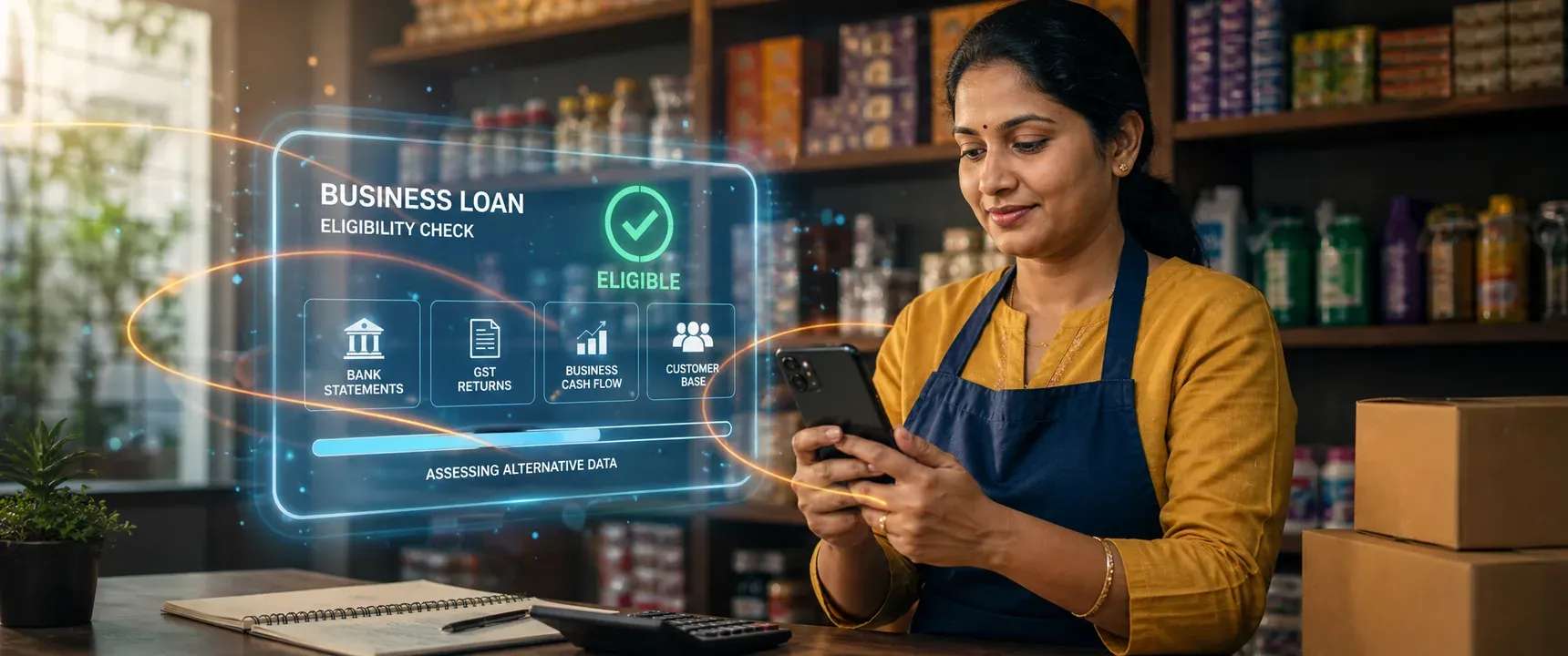
Table of content
Small business lending in India still asks for bank style certainty
Why old rules exclude new borrowers
What eligibility actually looks like
How digital lending can bridge the gap
What small businesses can do
The case for practical underwriting
FAQs
A shopkeeper in Pune restocks inventory every week using UPI payments from three different platforms. Her monthly income is real, but it never arrives on the same date or in the same amount. When she applies for a business loan, the lender asks for six months of salary slips. She does not have salary slips. She has bank deposits, GST returns, and a growing customer base. The system was not built for her. mPokket believes that small business lending in India can be designed to recognize how digital age borrowers actually earn and operate.
Follow our Whatsapp Community for more offers and updates.
Join nowIndia's MSME sector contributes significantly to the national economy. Yet a large proportion of micro and small enterprises still struggle to access formal credit. The core problem is not a lack of demand or repayment willingness. It is a mismatch between how lenders evaluate risk and how small businesses actually function.
Traditional business loan eligibility criteria were shaped by decades of branch banking. They assume a borrower has a fixed monthly salary, a property to pledge, audited financial statements, and a long credit history. These assumptions made sense when most borrowers were salaried employees or large firms.
Today, a growing share of India's workforce is self-employed, freelance, or gig based. A delivery partner earns daily. A freelance designer invoices monthly. A home based tiffin service owner deposits cash irregularly. Their income is genuine, but it does not fit the template that most lenders still use.
Business loan eligibility in India generally involves a few core requirements. The applicant should be an Indian national, typically 21 years or older. The business should have some operating history, often a minimum vintage of six months. Basic KYC documents such as Aadhaar and PAN are required. Proof of business activity, which could include GST registration, Udyam certificate, or bank statements showing regular transactions, is also expected.
Where lenders diverge is in how strictly they interpret these requirements. A traditional bank may insist on ITR filings, collateral, a high CIBIL score, and audited balance sheets. A digital lender like mPokket is designed to take a more practical approach, potentially accepting bank statement based assessment, alternative income proof, and minimal documentation.
The eligibility question is not just about meeting a checklist. It is about whether the checklist itself reflects the borrower's reality. When a lender demands three years of ITR from a two year old business, or a salary slip from someone who has never been salaried, the criteria become a barrier rather than a filter.
Digital lending platforms have the technology to evaluate borrowers differently. Instead of relying solely on a CIBIL score or collateral, they can analyze bank account activity, transaction frequency, and cash flow patterns. This alternative data assessment is designed to help reveal repayment capacity that traditional documents might not capture.
mPokket advocates for this kind of practical underwriting. A paperless application process, OTP based digital KYC, and direct bank transfer disbursal can reduce the friction that keeps small operators away from formal credit. When a cab driver or a small retailer can apply using Aadhaar and PAN, upload basic business proof, and receive funds without a branch visit, the lending process starts to match the borrower's digital reality.
This does not mean lowering standards. It means updating them. A borrower who consistently receives platform payments into a verified bank account may be a lower risk than someone with a high salary but heavy existing debt. The data exists. The question is whether lenders choose to read it.
While the lending system evolves, small business owners can take steps to strengthen their own eligibility. Maintaining a dedicated business bank account with regular activity is one of the most practical moves. Filing GST returns, even when not mandatory, creates a documented trail of business performance.
Obtaining Udyam registration as an MSME is free and can improve access to government backed schemes and digital lending products. Building a credit history through small, disciplined borrowing and on time repayment helps establish a credit profile that lenders can evaluate.
For freelancers and gig workers, keeping records of client invoices, platform earnings, and bank deposits from multiple sources can serve as alternative income proof. These documents may not look like a traditional salary slip, but they tell the same story: this person earns, and this person repays.
India's small business landscape is changing faster than its lending infrastructure. A woman running a stitching venture from home, a young founder selling products online, a cab driver saving for a second vehicle: these borrowers are not risky because their income is irregular. They are underserved because the system was not designed for them.
mPokket's perspective is that digital business lending should meet borrowers where they are. That means collateral free options, flexible documentation, and eligibility criteria that account for how modern small businesses actually operate. It means recognizing that a Udyam certificate and six months of bank statements can tell a lender more than a property deed in many cases.
The goal is not to eliminate risk assessment. It is to make risk assessment smarter. When lenders use alternative data, digital KYC, and cash flow based evaluation, they can serve more borrowers without compromising on repayment discipline. That is better for borrowers, better for lenders, and better for the economy.
If you are a small business owner, freelancer, or self-employed professional in India, the lending landscape is shifting in your direction. Platforms like mPokket are designed to offer a more practical path to business finance, one that does not ask you to pretend your income looks like a bank employee's paycheck. The opportunity is to build your documentation, maintain your financial discipline, and choose lenders who evaluate you on what you actually do, not on what a decades old template says you should look like.
Business loan eligibility in India generally requires Indian nationality, a minimum business vintage (often six months), KYC documents like Aadhaar and PAN, and proof of business activity. Digital lenders like mPokket may also accept bank statements and alternative income proof instead of traditional salary slips or ITR filings.
Eligibility criteria typically include age (usually 21 and above), valid KYC, a functioning business with some operating history, and evidence of income or cash flow. Traditional banks may require collateral and high CIBIL scores, while digital platforms can be designed to use alternative assessment methods for self-employed and MSME borrowers.
Yes. Collateral free business loans, also called unsecured business loans, are available from digital lenders and some NBFCs. Platforms like mPokket are designed to offer unsecured credit based on business performance, bank account activity, and KYC verification rather than requiring property or assets as security.
Common documents include Aadhaar card, PAN card, bank statements, GST registration or Udyam certificate, and proof of business activity. Digital lenders may accept a simplified document set, including alternative income proof such as client invoices or platform earnings, especially for self-employed and freelance applicants.
Self-employed borrowers can strengthen eligibility by maintaining regular bank account activity, filing GST returns, obtaining Udyam registration, and building credit history through small loans repaid on time. Keeping records of client invoices and platform deposits can also serve as alternative income documentation for digital lenders.
Does Udyam Registration Improve MSME Loan Eligibility?
2 min read • 10 September 2026
How to build a repayment routine that works with EMI, UPI, and autopay
3 mins min read • 21 September 2026
Which app gives loan without credit score in India
3 mins min read • 18 September 2026
₹1,000 Instant Loan: Why Can the Amount Credited Be Lower Than the Sanctioned Amount?
3 min read • 11 October 2026
