3 mins min read • 28 October 2026


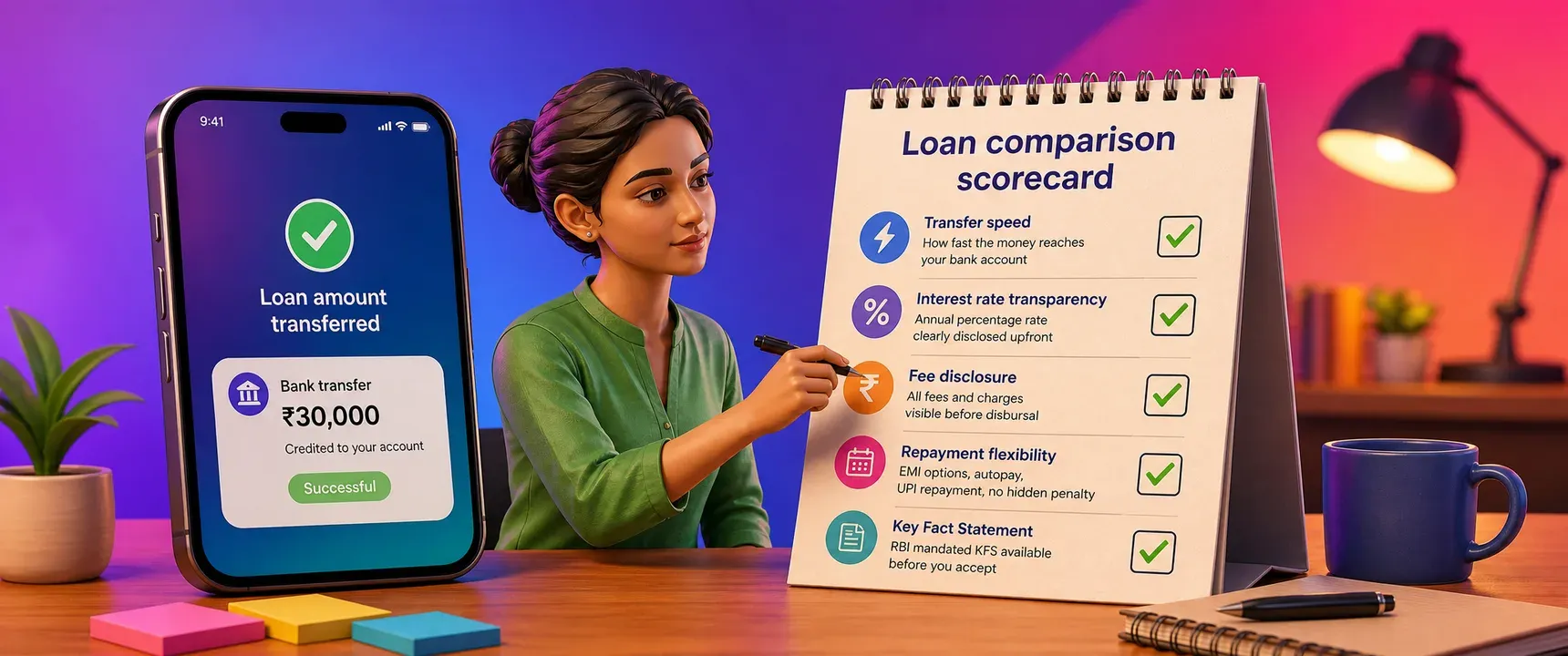
Table of content
Summary
What is a direct bank transfer loan?
Why speed without clarity fails
The five criteria scorecard
How to score transfer speed
How to score transparency
How to score repayment flexibility
Applying the scorecard: a worked example
When speed should weigh more
Building trust through scoring
FAQs
When you need money fast, the speed of a bank transfer can feel like the only thing that matters. But borrowers across India are learning a painful lesson: a loan that lands in your account in minutes can still cost you dearly if the interest rate, processing fee, or repayment schedule is buried in fine print. mPokket believes that quick disbursal and transparent borrowing terms are not competing priorities. They belong on the same scorecard.
What is a direct bank transfer loan? - A direct bank transfer loan sends approved funds straight to your verified bank account, skipping wallets or intermediaries. mPokket offers this feature so borrowers receive usable cash within minutes of approval.
Why does speed alone mislead borrowers? - Many loan apps advertise instant transfer but obscure total costs. A scorecard that weighs disbursal speed alongside interest rates, processing charges, and repayment clarity helps borrowers avoid hidden debt traps.
How does the scorecard work? - The decision matrix scores each loan option across five criteria: transfer speed, interest rate transparency, fee disclosure, repayment flexibility, and Key Fact Statement availability. Each criterion gets a weight based on urgency and financial impact.
Who benefits most from this framework? - Salaried employees, freshers, self-employed professionals, housewives, and gig workers in India who compare quick loan apps can use this scorecard to pick the option that balances speed with honest pricing.
What role does mPokket play? - mPokket is designed to combine instant bank account disbursal with upfront rate disclosure, flexible EMI options, and a paperless digital process, giving borrowers both speed and clarity in one experience.
Follow our Whatsapp Community for more offers and updates.
Join nowA direct bank transfer loan deposits approved funds into your personal or business bank account. There is no wallet, no voucher, and no intermediary step. The money is yours to spend on medical bills, rent, inventory, or any urgent need the moment it arrives.
mPokket uses this model. After a borrower completes digital KYC with Aadhaar and PAN, the approved amount can be transferred directly to a verified bank account. This matters because wallet based disbursals often carry withdrawal limits or merchant restrictions that slow down actual use of the funds.
For salaried employees facing a month end cash crunch, or a housewife managing an unexpected household expense, direct bank transfer removes friction between approval and spending. The question is whether that speed comes at a hidden price.
Speed is the loudest selling point in digital lending. Loan apps compete on who can disburse fastest. Some promise funds in seven minutes. Others claim same day approval. These claims attract borrowers in urgent situations, but they rarely address total borrowing cost.
A borrower who receives funds in ten minutes but pays an undisclosed processing fee, or faces a penalty for early repayment, ends up worse off than someone who waited an hour for a loan with clear terms. The Reserve Bank of India (RBI) has mandated that all digital lenders issue a Key Fact Statement before disbursal. This document lists the annual percentage rate, all fees, and the total repayment amount. Yet many borrowers skip reading it because the app interface prioritizes the "get money now" button.
The gap between perceived speed and actual cost is where mistrust grows. A scorecard bridges that gap by forcing a side by side comparison of what you gain in time and what you might lose in transparency.
This decision matrix scores any loan app or lender across five weighted criteria. Each criterion is rated on a scale of 1 to 5, where 5 is the strongest performance. The weights reflect how much each factor should influence a borrower's final decision.
| Criterion | Weight | What to evaluate | Score (1 to 5) |
|---|---|---|---|
| Transfer speed | 20% | Time from approval to funds in bank account | Rate based on actual disbursal experience |
| Interest rate transparency | 25% | Is the annual percentage rate clearly stated before you accept? | 5 if shown upfront; 1 if buried or absent |
| Fee disclosure | 20% | Are processing fees, late charges, and foreclosure charges listed before disbursal? | 5 if all fees visible; 1 if fees appear only after signing |
| Repayment flexibility | 20% | Can you choose EMI tenure, use autopay, or repay via UPI without penalty? | 5 if multiple options with no hidden penalty; 1 if rigid single option |
| Key Fact Statement availability | 15% | Does the app provide the RBI mandated Key Fact Statement before you accept the loan? | 5 if provided and easy to read; 1 if missing or hard to find |
To use this scorecard, list two or three loan options you are considering. Score each one across all five rows. Multiply each score by the weight, then add the weighted scores. The option with the highest total is your strongest choice.
Transfer speed is straightforward to measure. Note the time between final approval and the moment funds appear in your bank account. Some lenders quote approval time but not transfer time, which can add hours if the banking channel is slow.
mPokket is designed to transfer funds directly to a verified bank account after approval, using digital disbursal infrastructure. A score of 5 means funds arrive within minutes. A score of 3 means same day but with a noticeable delay. A score of 1 means next business day or longer.
Speed deserves a 20% weight because it matters most in genuine emergencies. For planned borrowing, such as a skill development course or home renovation, speed is less critical than cost clarity.
Interest rate transparency and fee disclosure together carry 45% of the total weight. This reflects a simple reality: a loan that costs more than you expected is worse than a loan that arrives a few minutes later.
Check whether the app shows the annual percentage rate on the same screen where you select the loan amount. Look for a breakdown of processing fees before you tap "accept." Verify that late payment charges and foreclosure terms are visible without scrolling through a separate terms page.
mPokket provides transparent loan terms and a Key Fact Statement as part of its digital lending process. Borrowers can review interest rates, EMI schedules, and total repayment amounts before accepting. This approach is designed to help borrowers make informed decisions rather than rushed ones.
Repayment flexibility covers tenure selection, autopay options, UPI repayment, and whether you face penalties for early closure. A lender that offers flexible EMI schedules and multiple repayment modes (autopay, UPI, debit card) earns a higher score than one that locks you into a single rigid plan.
mPokket offers EMI based repayment with options like autopay and UPI loan repayment. Borrowers can select a tenure that fits their cash flow, whether they earn a monthly salary, a weekly gig income, or a stipend. This flexibility is designed to reduce the risk of missed payments and the stress of rigid due dates.
A gig worker whose earnings change every week, or a fresher on a starting salary, benefits more from flexible repayment than from shaving two minutes off disbursal time.
Imagine a salaried employee in India comparing two loan apps for a Rs 30,000 emergency loan. App A transfers funds in 8 minutes but does not show the processing fee until after acceptance. App B transfers funds in 25 minutes but displays the annual percentage rate, all fees, and the Key Fact Statement on the loan selection screen.
| Criterion | Weight | App A score | App A weighted | App B score | App B weighted |
|---|---|---|---|---|---|
| Transfer speed | 20% | 5 | 1.00 | 3 | 0.60 |
| Interest rate transparency | 25% | 2 | 0.50 | 5 | 1.25 |
| Fee disclosure | 20% | 1 | 0.20 | 5 | 1.00 |
| Repayment flexibility | 20% | 3 | 0.60 | 4 | 0.80 |
| Key Fact Statement | 15% | 2 | 0.30 | 5 | 0.75 |
Total | 100% | 2.60 | 4.40 |
App B wins by a wide margin despite being slower. The 17 minute difference in transfer speed costs App B only 0.40 points, while App A loses 2.30 points on transparency and disclosure. This is the core insight: speed is valuable, but it rarely outweighs the cost of hidden charges.
There are situations where transfer speed genuinely matters more than usual. A medical emergency, an unexpected repair bill, or a sudden expense during an internship can make every minute count. In those cases, you might increase the speed weight to 30% and reduce other weights proportionally.
Even then, a lender that scores 4 on speed and 5 on transparency will usually beat one that scores 5 on speed and 2 on transparency. The scorecard adapts to your situation without abandoning the principle that clarity protects your finances.
mPokket is designed to serve both needs. Its paperless digital process and direct bank transfer aim for fast disbursal, while its upfront disclosure of rates and fees is designed to ensure borrowers understand what they owe before the money arrives.
The real value of a scorecard is not the final number. It is the habit of asking questions before accepting a loan. When you score a lender on fee disclosure, you are forced to look for the processing fee. When you score on Key Fact Statement availability, you are forced to read it.
This habit protects freshers taking their first loan, housewives borrowing for a home based business, self-employed professionals managing irregular cash flow, and gig workers who need funds between payouts. Every borrower segment benefits from structured comparison rather than impulse driven decisions.
mPokket supports this approach by providing a 100 percent online process with digital KYC, transparent loan terms, and flexible repayment options. The goal is to make the scorecard easy to fill out, because the answers are visible before you commit.
Use this scorecard the next time you compare quick loan apps. Score each option honestly. Let the weighted total guide your choice. Speed matters, but only when paired with the clarity that keeps your borrowing affordable and your repayment manageable.
A direct bank transfer loan sends approved funds straight to your verified bank account without using wallets or intermediaries. mPokket offers this feature, enabling borrowers to access usable cash within minutes of approval through a paperless digital process.
mPokket is designed to transfer loan amounts directly to a borrower's verified bank account after digital KYC and approval. This eliminates wallet restrictions and lets borrowers use funds immediately for any urgent need.
Use a weighted scorecard that evaluates transfer speed, interest rate transparency, fee disclosure, repayment flexibility, and Key Fact Statement availability. Score each app on these five criteria to find the option that balances speed with honest pricing.
Fast disbursal without clear terms can lead to hidden fees and unexpected repayment burdens. Evaluating transparency alongside speed helps borrowers avoid debt traps and choose lenders like mPokket that disclose rates and charges upfront.
A Key Fact Statement is an RBI mandated document that lists the annual percentage rate, all fees, and total repayment amount before loan acceptance. It helps borrowers understand the true cost of borrowing before funds are disbursed.
How to Choose the Right Digital Lending Platform: A Comparison Guide for 2026
4 min read • 12 May 2026
What Are the Most Common Business Loan Myths Holding Entrepreneurs Back?
3 min read • 19 August 2026
5 Ways Paperless Loan Applications Simplify Loan Access
4 min read • 7 May 2026
Need ₹10,000 Urgent Loan Today — What Should You Do To Get It Fast?
4 min read • 30 April 2026
