5 min read • 17 September 2026


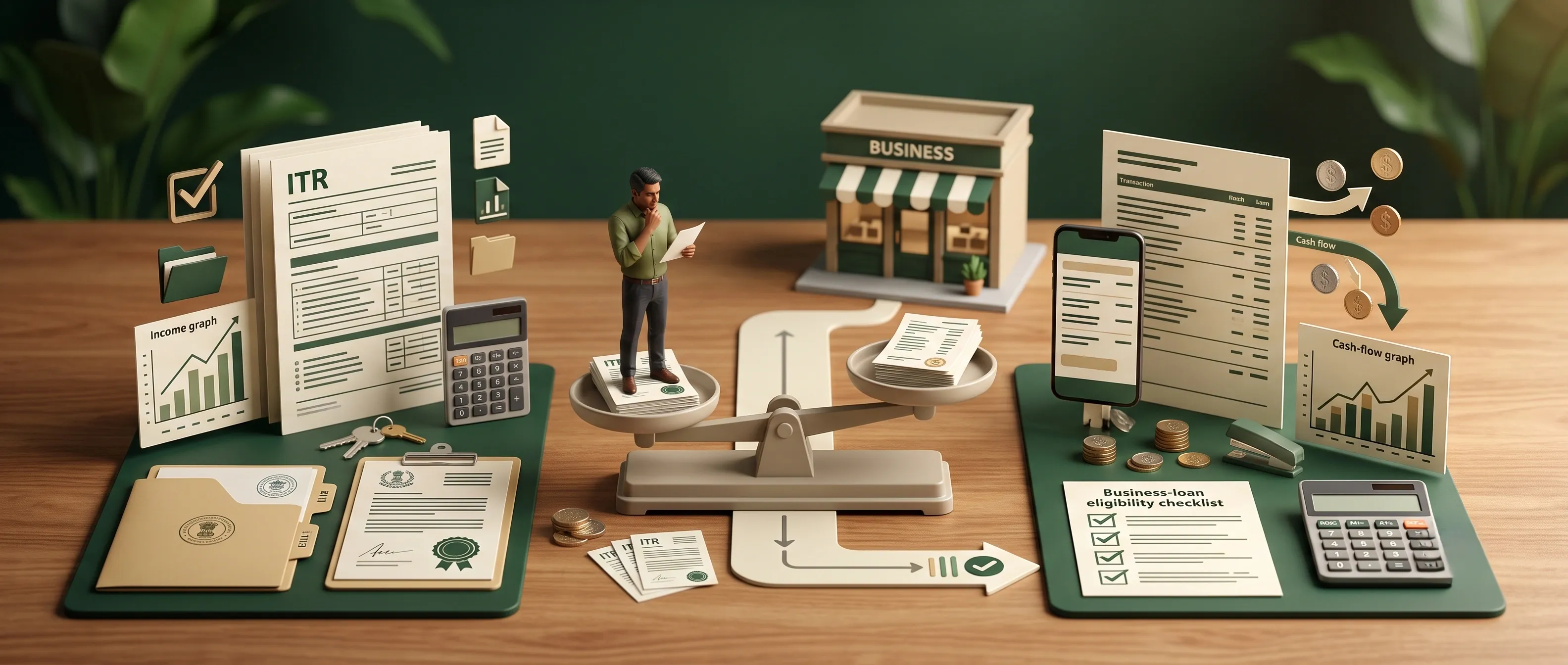
Table of content
Overview
Why Do Lenders Check Documents for Business Loan Eligibility?
What Is the Role of ITR in a Business Loan Application?
What Is the Role of Bank Statements in a Business Loan?
ITR vs Bank Statement: What Are the Key Differences?
Can You Get a Business Loan Without ITR?
How Do Bank Statements Help With Business Loan Instant Approval?
What Factors Affect My Business Loan Eligibility Most?
Conclusion
Frequently Asked Questions
Digging through old tax filings, only to realize your ITR doesn't really capture how the business is doing right now, that's a frustration plenty of small business owners hit the moment they start a business loan application. Maybe income has grown since the last filing. Maybe you're still new to formal tax filing altogether. Either way, the question of whether ITR or business loan bank statements carry more weight for business loan eligibility ends up mattering quite a bit.
Short answer first. Both ITR and bank statements factor into business loan eligibility, but lenders tend to treat bank statements as the more immediate, real-time proof of how a business is actually performing, while ITR offers a longer-term, government-verified income record.
Neither fully replaces the other. Depending on the lender, though, one can end up carrying noticeably more weight than the other. This blog gets into what each document really does for your application, whether a business loan without ITR is genuinely possible, how bank statements can speed things up, and what else lenders look at beyond just paperwork.
Follow our Whatsapp Community for more offers and updates.
Join nowLenders check documents mainly to confirm a business actually earns what it claims and can realistically pay back what it's asking to borrow. Without that verification, every application would basically be a guess dressed up as data.
A few reasons documents end up mattering this much:
Different documents end up telling different parts of the story here, which is exactly why ITR and business loan bank statements don't always align.
ITR hands lenders a government-verified snapshot of declared income across the past few years, which helps establish long-term financial credibility. It's one of the more trusted pieces of paper in a typical business loan application.
A few specific things ITR helps with:
That said, ITR isn't always current. A business that's grown a lot in the last few months might not see any of that reflected in its most recent filing yet.
Bank statements show real-time cash flow, giving lenders a live view of how money is actually moving through the business day to day. This tends to be the document that matters most when a decision needs to happen fast.
Specifically, here's what bank statements reveal:
Since business loan bank statements capture what's happening right now, they carry more weight when speed is the priority, and that leads straight into the next point.
ITR reflects declared, tax-verified income from past years, while a bank statement shows live, ongoing cash flow. Both matter, sure, but each one is really answering a slightly different question for the lender.
Most lenders end up leaning on both together, since each one fills a gap the other leaves open.
Yes, a business loan without ITR is actually possible with a good number of lenders if you can provide other proofs like bank statements, GST returns, business registration documents, etc. It's more common than most people assume.
This works particularly well for:
In many of these cases, a good credit score and clean bank statement history does a lot of the heavy lifting that ITR would normally do.
Bank statements make instant approval for business loans faster, as digital lenders can verify cash flow almost instantly with automated checks, eliminating the need for manual document review. That alone cuts processing time down considerably.
Here’s roughly how that speed translates in practice:
This is, in fact, why business loan bank statements tend to become more important in practical terms than ITR, especially if someone is in dire need of funds.
Cash flow consistency, credit score, and repayment history tend to matter the most overall, though how much weight ITR gets versus bank statements really comes down to the individual lender's process. Some lean heavily on tax records; others rely more on live banking data.
Traditional banks often insist on ITR for larger, longer-tenure loans, and that can leave newer businesses, or ones without much tax filing history, stuck outside looking in. Some digital lenders take a different route here. mPokket, for one, leans on alternative data scoring rather than treating ITR as mandatory, focusing instead on cash flow patterns and repayment behavior to judge business loan eligibility.
This can be very helpful for business owners without a long ITR history if their bank statements and repayment capacity are good. mPokket provides business loans up to ₹2 lakh and is usually approved within minutes. Eligibility still ultimately depends on the specific lender and the loan amount involved, though, so it's worth comparing your options based on whatever documentation you actually have.
Bank statements and ITR are both important for business loan eligibility, but in different ways. ITR builds a longer-term, verified picture of income, while bank statements show what's happening with cash flow right now, and that immediacy is often what makes them the more decisive document when approval needs to happen fast.
If your business doesn't have much of an ITR history yet, that's not necessarily a dead end. Lenders willing to look at alternative data can still offer a real path forward, as long as your financial activity tells a consistent, credible story.
Need quick funds for your business? Check your business loan eligibility on mPokket and see your options in minutes.
1. Is ITR mandatory for a business loan?
Not always. While ITR is the preferred document for bigger loans, many lenders are okay with other documents such as bank statements or GST returns (for smaller ticket business loans).
2. Are bank statements required for a business loan?
Yes, in most cases. Bank statements are almost always requested since they show real-time cash flow, and that helps lenders judge repayment capacity fairly quickly.
3. Which is better for business loan instant approval: ITR or bank statement?
Neither one's strictly "better" on its own. ITR shows long-term, verified income, while bank statements reflect current cash flow. Most lenders consider both together to get the whole picture.
4. Can I get a business loan without ITR?
Yes, there are a few lenders who offer a business loan without ITR. They depend on bank statements, GST filings, or alternative data scoring to offer a business loan without ITR, especially to newer or smaller businesses.
5. How can I get faster business loan approval?
Keeping the bank statements clean and consistent, keeping a healthy credit score, and choosing a digital lender that verifies documents electronically all help speed up the approval quite a bit.
Business Loan Documents Required for MSMEs and Small Businesses
3 min read • 29 July 2026
Working Capital Loan: Everything Small Businesses Should Know
5 min read • 17 July 2026
What Small Business Owners Need Before Seeking Funds in India?
4 min read • 12 May 2026