3 mins min read • 6 October 2026


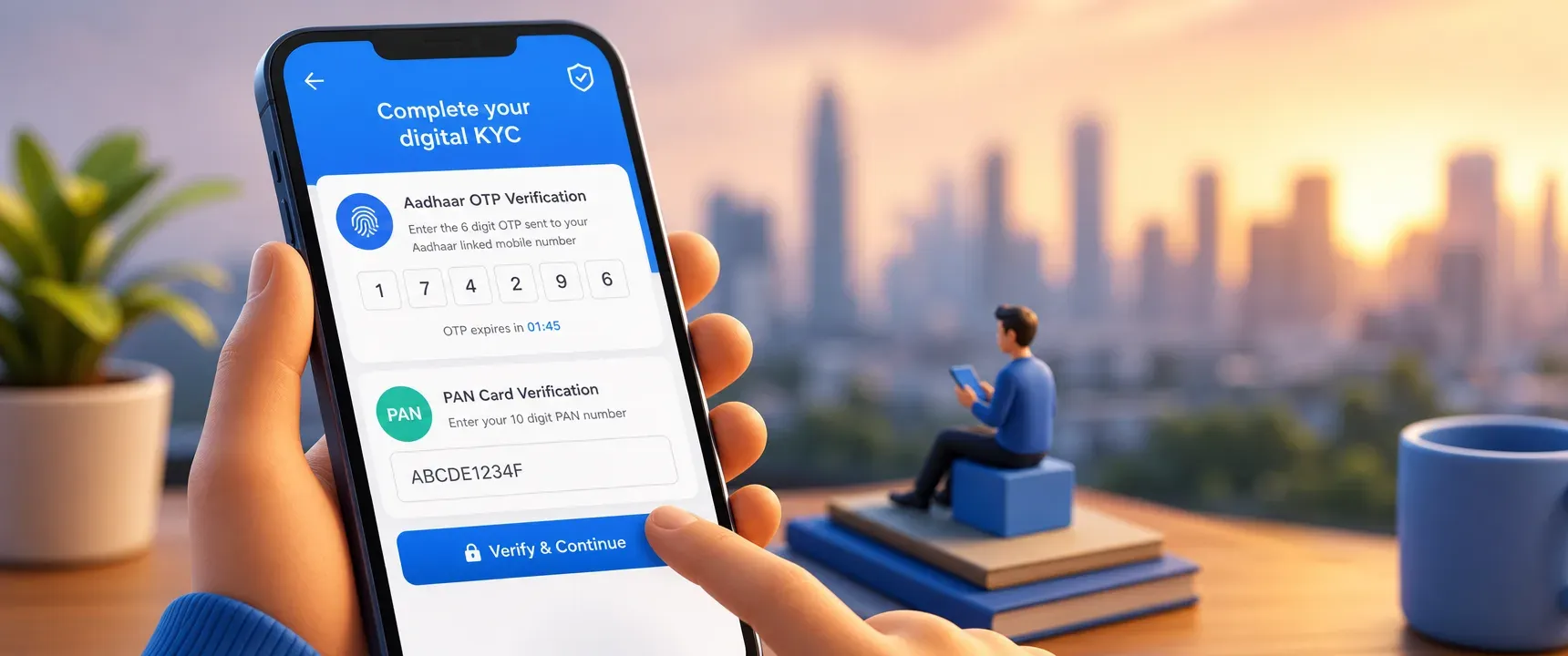
Table of content
Overview
What is digital KYC?
Step by step KYC flow
Role of Aadhaar and PAN
How OTP verification works
Safety and compliance
Why digital KYC enables speed
FAQs
You tap "apply" on a personal loan app, and within minutes the app says you are verified. No branch visit, no photocopies, no waiting in line. For first time borrowers in India, that speed can feel suspicious rather than reassuring. Understanding how digital KYC actually works inside a loan app like mPokket removes that doubt and shows why paperless verification is both fast and compliant.
Follow our Whatsapp Community for more offers and updates.
Join nowKYC stands for Know Your Customer. In traditional lending, it meant carrying physical documents to a bank branch, getting them photocopied, and waiting for manual verification. Digital KYC replaces every one of those steps with electronic checks.
Under RBI's digital lending guidelines, regulated entities and their lending service providers must verify borrower identity through government databases. That means the app connects directly to UIDAI for Aadhaar authentication and to the Income Tax database for PAN validation. No paper changes hands.
For a personal loan app like mPokket, digital KYC is the foundation of the entire paperless loan experience. It is what allows approval within minutes rather than days.
The verification journey inside a loan app typically follows a clear sequence. Here is how it works on mPokket and similar digital lending platforms in India.
| Step | What happens | Why it matters |
|---|---|---|
| 1. Mobile number registration | You enter your mobile number and receive an OTP from the app | Confirms you own the device and number linked to your identity |
| 2. Aadhaar OTP verification | You provide your Aadhaar number; UIDAI sends an OTP to your Aadhaar linked mobile | Authenticates your identity against the government database without biometrics |
| 3. PAN card validation | You enter your PAN; the app cross checks it with the Income Tax database | Confirms your tax identity and enables financial background checks |
| 4. Selfie verification | You take a live selfie that the app matches against your Aadhaar photo | Prevents impersonation and confirms the real person is applying |
| 5. Document upload | You upload supporting proof such as income documents or student ID | Helps the lender assess repayment capacity beyond identity alone |
| 6. Profile completion | You fill in personal and employment details | Rounds out the application for underwriting and credit assessment |
Each step feeds into the next. If any check fails, the app flags it immediately rather than letting the application proceed to a dead end.
Aadhaar and PAN serve different but complementary purposes. Aadhaar, issued by UIDAI, is a 12 digit identity number linked to your biometrics and demographics. When a loan app like mPokket triggers Aadhaar OTP authentication, UIDAI confirms your name, date of birth, and address electronically.
PAN, issued by the Income Tax Department, is a 10 character alphanumeric code tied to your tax records. It lets the lender verify your financial identity and, where applicable, check past tax filings or credit bureau records.
Together, Aadhaar and PAN satisfy the two pillars of RBI's KYC requirements for digital lending: proof of identity and proof of address. This is why most instant personal loan apps in India ask for both documents upfront.
OTP based verification is the mechanism that makes paperless KYC possible without requiring in person biometric scans. When you enter your Aadhaar number, the app sends an authentication request to UIDAI. UIDAI then sends a six digit OTP to the mobile number registered with your Aadhaar.
You enter that OTP in the app. If it matches, UIDAI confirms your identity to the lender's system. The entire exchange happens over encrypted channels, and the OTP expires within a short window, reducing the risk of misuse.
This OTP based digital KYC method is specifically permitted under RBI norms for regulated lenders. It removes the need for a physical visit while maintaining the same level of identity assurance.
First time borrowers often worry about sharing Aadhaar and PAN with an app. That concern is reasonable. RBI's digital lending guidelines (updated in 2022 and reinforced through subsequent circulars) set clear rules for how lender apps must handle personal data.
Regulated lenders like mPokket are required to collect data only with explicit borrower consent. They must encrypt sensitive information during transmission and storage. They cannot share your KYC data with unauthorized third parties. Borrowers also have the right to know what data has been collected and request its deletion after the loan relationship ends.
Selfie verification adds another layer. By matching a live photo against the Aadhaar database image, the app confirms that the person holding the phone is the actual applicant. This step is designed to prevent identity fraud.
Traditional KYC could take days because documents had to be physically collected, manually reviewed, and cross referenced. Digital KYC compresses that timeline because every check is automated.
Aadhaar authentication returns a result in seconds. PAN validation is similarly instant. Selfie matching uses image recognition algorithms that process in real time. When all checks pass, the app can move directly to credit assessment and, if approved, disbursal to your verified bank account.
This is how apps like mPokket can offer instant personal loans with approval within minutes. The speed is not a shortcut around verification. It is the result of replacing manual steps with electronic ones, each backed by government databases.
For borrowers, this means no branch visit, no courier, and no waiting for a verification officer. For lenders, it means lower operational costs and fewer errors in identity checks. Both sides benefit from the same digital infrastructure.
If you are applying for a paperless loan through mPokket, keep your Aadhaar linked mobile number active, your PAN details handy, and be ready for a quick selfie. Those three things are all the preparation digital KYC requires.
Digital lending in India works through loan apps and online platforms that use electronic KYC, automated credit assessment, and direct bank transfer for disbursal. RBI regulated lenders like mPokket verify identity using Aadhaar and PAN, then approve and transfer funds without any branch visit.
Yes. Aadhaar and PAN are the primary KYC documents for digital personal loans in India. Apps like mPokket use OTP based Aadhaar authentication and PAN validation to verify your identity electronically, enabling a fully paperless loan application.
Download a loan app like mPokket, register your mobile number, complete digital KYC with Aadhaar and PAN, upload any required income proof, and submit your application. If approved, funds can be disbursed directly to your verified bank account within minutes.
You need your 12 digit Aadhaar number with an active linked mobile number for OTP, your 10 character PAN, and the ability to take a live selfie. Some apps like mPokket may also ask for income proof or a student ID depending on your profile.
Flexi Personal Loan vs. Personal Loan: Which One Should You Choose?
4 min read • 13 August 2026
How digital lending works in India step by step
5 min read • 10 September 2026
5 Reasons Your Business Needs a Working Capital Loan
4 min read • 28 July 2026
Which Is The Most Trusted Loan App In India?
4 min read • 1 May 2026