4 min read • 16 July 2026


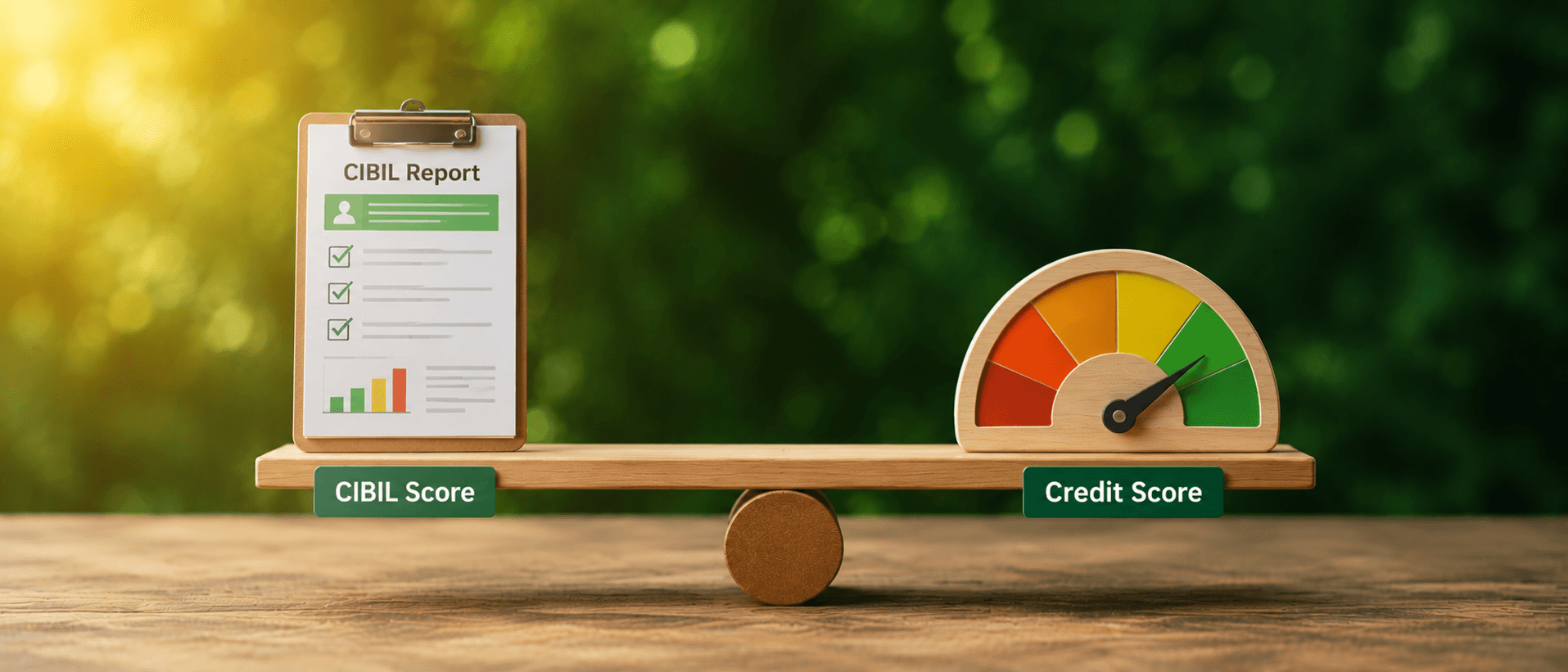
Table of content
Don't Let the Difference Between Credit Score and CIBIL Score Confuse You.
What Is a Credit Score?
What Is a CIBIL Score?
What Are The Core Differences Between Credit Score and CIBIL Score?
How to Improve Your Credit Score and CIBIL Score?
Which App Offers Personal Loans Using Alternative Credit Scoring?
Quick Takeaways: Difference Between Credit Score and CIBIL Score
Frequently Asked Questions
Most people use both terms like they mean the same thing, and honestly, that mix-up can cost you a good loan deal. It can affect your loan application, credit decisions, and even the interest rate you're offered.
Here's the simple explanation. A credit score is the umbrella term for any three-digit number that shows how trustworthy you are with credit. On the other side, your CIBIL score is just one version of it, which is calculated by TransUnion CIBIL, one of India's four credit bureaus.
So every CIBIL score is a credit score, but not every credit score is a CIBIL score. Simple enough, right?
In this guide, we'll break down what each score really means, how they're different, how you can improve them, and where to get a loan even if your score isn't picture-perfect.
Whether you're a student, a fresher just starting out, or a small business owner without formal income proof, understanding this difference between credit score and CIBIL score will help you make smarter borrowing decisions.
Follow our Whatsapp Community for more offers and updates.
Join nowYour credit score is a 3-digit number, usually between 300 and 900, that sums up how you've handled credit in the past. A credit bureau studies your repayment behavior and runs it through its own formula to arrive at this figure.
The logic is pretty simple. The higher the number, the more disciplined you've been with EMIs and card payments. Most lenders in India start feeling comfortable once your score crosses 700, though the exact cutoff varies from bank to bank.
Suppose you've paid every credit card bill on time for the last two years and never missed an EMI on your bike loan. Your credit score sits at 780, and when you apply for a personal loan, your bank approves it within a day. Compare that to someone who's defaulted once or twice, even if it was years ago, that dent tends to linger.
A few things quietly shape this number every month:
CIBIL stands for Credit Information Bureau (India) Limited. A CIBIL score is the specific credit score generated by TransUnion CIBIL, India's oldest and most widely referenced credit bureau. It's the one most banks default to when checking your loan application.
Here's the part people often get wrong: a credit score can come from any of these four bureaus, but a CIBIL score can only come from CIBIL. All four scores carry equal legal standing, yet in practice, most Indian banks reach for the CIBIL score first, simply because CIBIL has been around the longest and holds the richest repayment history on Indian borrowers.
So when a bank rejects a loan citing a "low CIBIL," they usually mean the score pulled specifically from this one bureau, not from Equifax or CRIF High Mark.
Ranging from 300 to 900, a score above 750 is generally considered solid ground for loan approval. Here's what shapes it:
CIBIL pulls data from banks and NBFCs about your credit cards, loans, EMIs, and repayment patterns, then runs it through its own algorithm. Missed payments, high credit utilization, or too many loan inquiries in a short span can drag the number down fast.
Because it's been around since 2000 and has the deepest historical data on Indian borrowers, most lenders trust it more than newer bureaus. That's largely why "CIBIL score" and "credit score" get used interchangeably in everyday conversation.
A CIBIL score is just one number, while a CIBIL report is the full document behind that number. It lists every loan, card, and EMI you've had, along with how regularly you paid them. Here's a quick side-by-side to make it stick:
Improving both scores comes down to consistent, disciplined credit behavior over time. There's no shortcut, but small habits compound fast. Let's look at what actually moves the needle.
None of this happens overnight. Give it three to six months of consistent behavior, and you'll usually start seeing the number climb.
mPokket offers instant personal loans up to ₹2 lakh without insisting on a flawless CIBIL score or traditional income proof, using alternative data instead. That's genuinely rare in a market obsessed with credit history.
Most banks won't even glance at your application if you're a fresher without a CIBIL history, an intern, or a small business owner without payslips. mPokket flips that script:
So if your CIBIL score isn't where you'd like it yet, or you simply haven't had the chance to build one, that doesn't have to be the end of the road.
Don't let a low or missing credit score hold your plans back. Apply for an instant personal loan with mPokket today and get funds up to ₹2 lakh, even without a perfect CIBIL score or formal income proof.
You get one free look at your CIBIL score every year directly on their official website. For credit scores, just visit the websites of other bureaus. But honestly, the easiest way right now is just opening your main banking or payment app. Most of them let you track your score for free right on the home screen.
Yes, 100%. Lenders see a high score and instantly view you as a safe bet. That means you get access to some serious perks, like larger loan amounts, cheaper interest rates, and approvals that push through way faster. It’s basically the biggest advantage you have when asking for money.
In India, most banks and NBFCs specifically pull your TransUnion CIBIL report. They’ve just been around the longest, so their data history is massive. Every now and then a lender might cross-check your numbers with Experian or Equifax depending on their own internal rules, but CIBIL is definitely the industry standard.
Both matter, but practically speaking, your CIBIL score carries more weight in India simply because it's checked most often. That said, keeping all your bureau scores healthy gives you more flexibility across lenders.
How to Get a Personal Loan For Low CIBIL Score?
2 min read • 23 June 2026
How a Short-Term Loan Can Improve Your CIBIL Score?
4 min read • 12 December 2023
How Quickly Can Salaried Individuals Get Approved for an Instant Loan?
4 min read • 27 May 2026
What are the Key Factors Lenders Consider When Making Low-Salary Instant Loans?
2 min read • 9 July 2025