3 mins min read • 28 September 2026


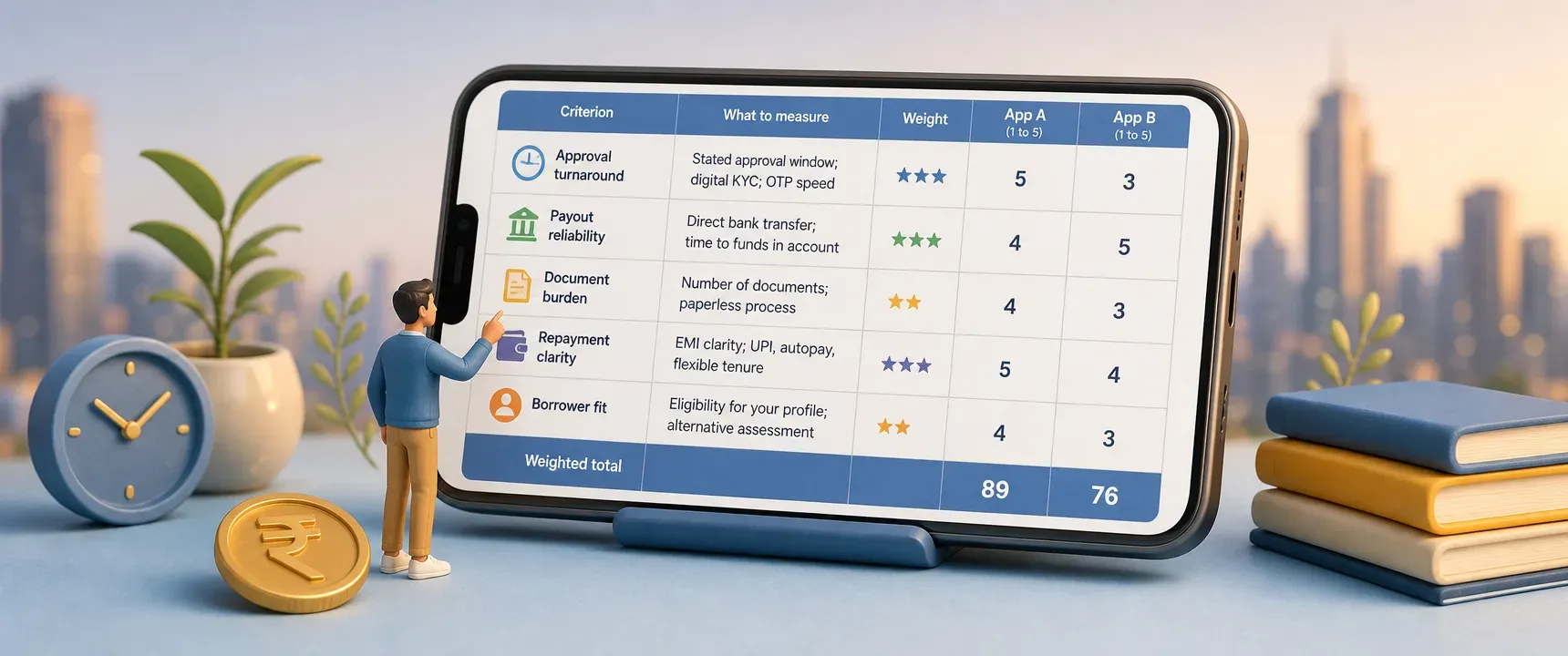
Table of content
Summary
Why most comparisons fail
Five criteria that define speed
The decision matrix
How to score each criterion
Putting the scorecard to work
FAQs
What is a loan app scorecard? - A scorecard is a structured framework that converts vague claims like "instant approval" into measurable criteria such as approval time, document burden, payout method, repayment clarity, and borrower fit. It helps you compare personal loan apps objectively instead of relying on marketing promises.
Why does speed need scoring? - Speed has multiple layers. An app can approve fast but disburse slowly, or disburse quickly but hide repayment terms. Scoring each layer separately reveals which app genuinely delivers when time pressure is real. mPokket's paperless, digital KYC process is designed to perform well across all speed dimensions.
Which five criteria matter most? - Approval turnaround, payout reliability (direct bank transfer timing), document burden (paperless versus upload heavy), repayment transparency (EMI clarity, flexible options, UPI or autopay), and borrower fit (eligibility for salaried, self-employed, freshers, gig workers, or housewives).
How do I use the decision matrix? - Rate each app on a 1 to 5 scale across the five criteria. Weight the criteria by your personal priority. Multiply, sum, and compare totals. The app with the highest weighted score is your strongest match for speed and trust.
Where does mPokket fit? - mPokket is designed to score well on paperless application (Aadhaar and PAN based digital KYC), quick approval within minutes, direct bank transfer disbursal, flexible EMI repayment with UPI and autopay options, and broad eligibility covering freshers, interns, salaried employees, and self-employed borrowers.
Follow our Whatsapp Community for more offers and updates.
Join nowSearch results for "best loan app in India" typically list features without structure. You see approval time claims, interest rate ranges, and download counts. None of these tell you whether the app fits your specific situation under time pressure.
The problem is dimensional. Speed is not one thing. It spans how quickly you complete KYC, how fast the lender underwrites your profile, and how soon funds reach your verified bank account. A single star rating collapses all of that into noise.
A scorecard fixes this by separating each dimension. You evaluate apps criterion by criterion, assign weights based on what matters to you, and arrive at a defensible choice. mPokket encourages this approach because structured evaluation tends to reward apps that invest in genuine process efficiency rather than headline claims.
The scorecard rests on five pillars. Each one captures a distinct part of the borrowing experience where delays, confusion, or hidden friction can cost you time or money.
This measures the gap between submitting your application and receiving a clear approval or rejection. Look for apps that state a specific window. mPokket's digital process is designed to deliver approval within minutes through OTP based verification and automated underwriting. Vague phrases like "fast approval" without a stated timeframe should score lower.
Approval means nothing if disbursal lags. Score this criterion on whether the app transfers funds directly to your verified bank account and how quickly that transfer completes after approval. Direct bank transfer is the safest payout method. Apps that route through wallets or intermediaries add delay and reduce usable liquidity.
Count the steps between downloading the app and completing your application. A truly paperless loan app requires only Aadhaar, PAN, and basic profile details submitted digitally. mPokket uses PAN and Aadhaar based digital KYC with selfie verification, which is designed to eliminate branch visits and physical paperwork. Apps that demand salary slips, bank statements, or employer letters score lower on this criterion, especially for freshers, gig workers, or self-employed borrowers who may not have traditional documentation.
Speed at the front end is wasted if repayment terms are confusing at the back end. Score apps on whether they clearly display EMI amounts, tenure options, total interest, and repayment modes before you accept the loan. Look for flexible repayment options such as UPI repayment, autopay EMI, and in app repayment. mPokket is designed to offer EMI repayment with UPI and autopay options, giving borrowers visibility and control over their repayment schedule.
An app can be fast and transparent but irrelevant if you do not meet its eligibility criteria. Score this on how well the app serves your borrower profile. mPokket is designed to serve a broad range of borrowers including salaried employees, self-employed professionals, freshers, interns with stipend income, gig workers, freelancers, and housewives. Apps with narrow eligibility (only salaried employees with high CIBIL scores, for example) score lower for borrowers outside that band. Some lenders, including mPokket, can use alternative data assessment for applicants without a traditional credit history.
Use the table below to score any personal loan app you are considering. Rate each criterion from 1 (poor) to 5 (excellent). Assign a weight from 1 to 3 based on your personal priority. Multiply the score by the weight for each criterion, then sum the weighted scores to get a total.
| Criterion | What to measure | Weight (1 to 3) | App A score (1 to 5) | App B score (1 to 5) |
|---|---|---|---|---|
| Approval turnaround | Stated approval window; digital KYC; OTP verification speed | Your priority | Rate here | Rate here |
| Payout reliability | Direct bank transfer; time from approval to funds in account | Your priority | Rate here | Rate here |
| Document burden | Number of documents; paperless process; Aadhaar and PAN only | Your priority | Rate here | Rate here |
| Repayment clarity | EMI display before acceptance; UPI, autopay, flexible tenure options | Your priority | Rate here | Rate here |
| Borrower fit | Eligibility for your profile; alternative assessment for no credit history | Your priority | Rate here | Rate here |
Weighted total | Sum | Sum |
A borrower facing a medical emergency might weight approval turnaround and payout reliability at 3 each, while weighting document burden at 2. A fresher building credit for the first time might weight borrower fit and repayment clarity highest. The matrix adapts to your situation.
Scoring requires checking specific, observable facts rather than relying on app store reviews. Here is what to look for in each column.
For approval turnaround, open the app or website and find the stated approval time. If the app says "approval in 7 minutes" or "approval within minutes," that is verifiable. If it says only "fast" or "instant" without a number, score it a 2 or lower. Check whether the app uses digital KYC with OTP verification, which eliminates manual review delays.
For payout reliability, confirm that the app transfers funds to a verified bank account, not a wallet. Check user forums or the app's FAQ for reported disbursal times after approval. mPokket is designed to disburse directly to your bank account after approval, which can help reduce the gap between approval and usable funds.
For document burden, count the required inputs. A score of 5 means only Aadhaar, PAN, selfie, and basic profile details. Each additional document (salary slip, bank statement, employer letter, ITR) drops the score by one point. Paperless loan apps that accept digital document submission through the app score higher than those requiring physical uploads or branch visits.
For repayment clarity, check whether the app shows your exact EMI amount, total interest, and tenure before you accept the loan offer. Verify whether it supports multiple repayment modes (UPI, autopay, debit card, in app payment). An EMI calculator visible before application is a strong signal. Hidden fees or unclear prepayment terms drop the score.
For borrower fit, check the eligibility page. Does the app serve your specific profile? If you are a fresher, does it accept applicants without credit history? If you are self-employed, does it accept alternative income proof? If you are a housewife, does it offer loans without formal salary documentation? mPokket is designed to serve borrowers across these categories, which can help it score well on this criterion for a wide range of applicants.
Certain patterns should automatically reduce an app's score on your matrix. Watch for these warning signs.
No RBI registration disclosure on the app or website is a serious concern. Legitimate digital lending platforms in India operate under RBI guidelines. Always verify that the lender or its partner NBFC is registered.
Vague interest rate ranges without a clear explanation of how your rate is determined suggest hidden costs. A transparent app shows you the applicable rate based on your profile before you accept.
Aggressive permission requests (access to contacts, photos, or files unrelated to KYC) are a red flag. A paperless loan app needs camera access for selfie verification and storage access for document upload. It does not need your contact list.
No clear grievance redressal mechanism or customer support channel means you have limited recourse if something goes wrong. Check for in app support, email, or a published complaint process.
Start by listing two or three apps you are considering. Fill in the matrix for each one using the observable checks described above. Weight the criteria based on your urgency and profile.
If your weighted total for one app is significantly higher than the others, that is your strongest option. If scores are close, revisit the criterion you weighted highest and look for a tiebreaker. For example, two apps might score equally on approval turnaround, but one offers UPI autopay while the other requires manual bank transfer for repayment. That difference matters over the life of the loan.
mPokket is designed to perform well across all five criteria for borrowers who value a paperless, mobile first process with digital KYC, direct bank transfer disbursal, and flexible EMI repayment. The scorecard approach helps you verify that for yourself rather than taking any app's marketing at face value.
Borrowers who use a structured framework like this tend to make faster, more confident decisions. They also avoid the regret that comes from choosing based on a single headline claim. Whether you choose mPokket or another app, the scorecard ensures your decision is grounded in what actually matters when speed is the priority.
Several apps claim instant approval, but the term means different things. Look for apps that state a specific approval window, use digital KYC with OTP verification, and disburse directly to your bank account. mPokket is designed to offer approval within minutes through a paperless, Aadhaar and PAN based process.
The best paperless loan apps require only Aadhaar, PAN, and a selfie for KYC. They complete verification digitally without branch visits. mPokket uses this approach and is designed to approve and disburse loans through a fully online, mobile first application process.
Use a scorecard with five criteria: approval turnaround, payout reliability, document burden, repayment clarity, and borrower fit. Rate each app from 1 to 5 on each criterion, weight by your priority, and compare totals. This structured approach reveals which app genuinely delivers speed.
Some digital lenders, including mPokket, are designed to use alternative data assessment for borrowers without a traditional credit score. Eligibility may depend on factors like Aadhaar and PAN verification, income indicators, and profile completeness rather than CIBIL score alone.
Verify RBI registration or NBFC partnership, check the stated approval and disbursal time, confirm direct bank transfer payout, review repayment options (EMI, UPI, autopay), and ensure the app serves your borrower profile. A scorecard covering these five areas can help you decide objectively.
5 Reasons Your Business Needs a Working Capital Loan
4 min read • 28 July 2026
What Is an NBFC Loan and How Does It Work?
3 July 2026
How to build a repayment routine that works with EMI, UPI, and autopay
3 mins min read • 21 September 2026
Which App Gives An Instant Loan In 5 Minutes In India?
4 min read • 15 April 2026