4 mins min read • 25 September 2026


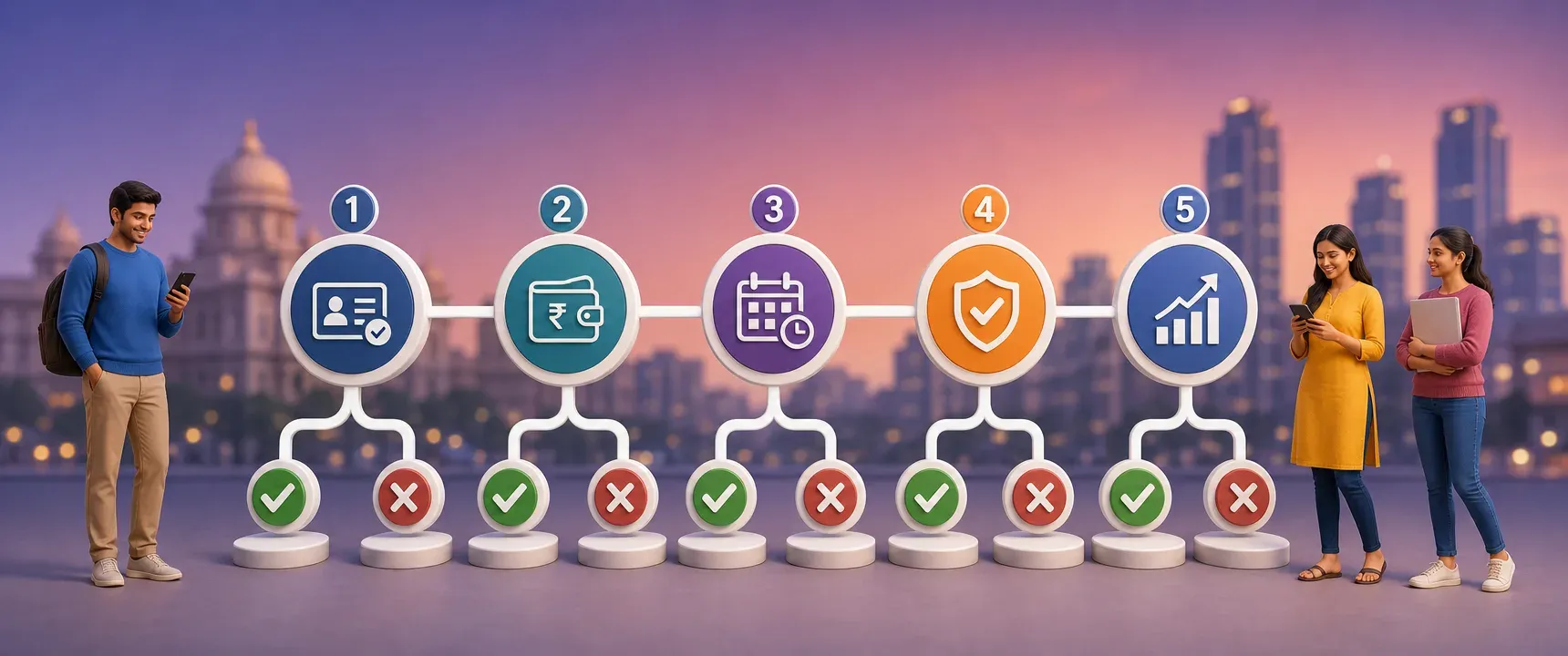
Table of content
Overview
Why no credit history blocks you
When to pause instead of borrow
How alternative assessment works
Choosing the right loan amount
FAQs
You earn money. You pay rent. You cover your own expenses. Yet when you open a loan app, the system treats you like a ghost because you have never borrowed formally. For freshers, interns, gig workers, and first time earners across India, the absence of a credit score creates a paradox: you need credit to build credit, but nobody offers credit without a score. mPokket addresses this gap through alternative assessment, but even with inclusive lenders available, the real question remains. Should you borrow now, how much should you take, and how do you pick a trustworthy digital lender? This decision tree walks you through each checkpoint.
Follow our Whatsapp Community for more offers and updates.
Join nowTraditional lenders rely on CIBIL scores to gauge risk. If you have never taken a loan or used a credit card, your score is either zero or nonexistent. Banks interpret this as unknown risk and reject applications outright.
This affects millions of Indians. College graduates entering the workforce, homemakers managing household finances independently, delivery partners earning through platforms, and freelancers with project based income all fall into this category. They are not risky borrowers. They are simply invisible to the credit system.
Digital lending platforms like mPokket solve this through alternative assessment. Instead of demanding a credit score, they evaluate identity documents (Aadhaar and PAN), income signals, occupation proof, and behavioral data. This approach is designed to help first time borrowers access small, unsecured loans without collateral or a guarantor.
Before you apply for your first digital loan, walk through these five checkpoints in order. Each one builds on the previous. If you cannot clear a checkpoint confidently, pause and revisit before proceeding.
Eligibility for a loan without credit history depends on a few basic requirements. You need valid identity documents, a verified bank account, and some form of income. The table below scores each criterion so you can assess your readiness.
| Criterion | What lenders check | Your readiness (yes / partial / no) | Action if partial or no |
|---|---|---|---|
| Identity verification | Aadhaar card and PAN card linked to mobile | Score yourself | Complete Aadhaar PAN linking online |
| Age requirement | Typically 18 years or older | Score yourself | Wait until eligible age |
| Indian nationality | Indian resident with valid documents | Score yourself | Ensure documents reflect current address |
| Active bank account | Verified bank account for direct disbursal | Score yourself | Open a savings account with any bank |
| Income signal | Salary slip, stipend proof, freelance invoices, or bank statement showing regular deposits | Score yourself | Gather 2 to 3 months of income evidence |
| Mobile number registration | Active mobile number linked to Aadhaar | Score yourself | Update mobile number with UIDAI |
If you score "yes" on all six criteria, proceed to checkpoint 2. If any criterion shows "no," resolve it first. mPokket's paperless application process uses OTP based digital KYC, so having linked documents saves significant time.
Eligibility does not equal affordability. Just because a lender approves you does not mean the loan fits your budget. Calculate your monthly surplus before deciding how much to borrow.
Use this formula: Monthly income minus fixed expenses (rent, food, transport, utilities) minus existing obligations equals surplus. Your EMI should not exceed 30% of this surplus for a first loan. Borrowing beyond that threshold creates repayment stress, especially on a starting salary or stipend income.
For example, if your monthly income is Rs 20,000 and fixed expenses total Rs 14,000, your surplus is Rs 6,000. A safe EMI ceiling would be Rs 1,800. Use a personal loan EMI calculator to check whether the loan amount you want fits within this limit at the offered interest rate and tenure.
If the EMI exceeds your safe ceiling, reduce the loan amount or extend the tenure. Do not borrow more than you need for the specific expense, whether that is a medical bill, month end cash crunch, or upskilling course.
Confidence is not just emotional. It is structural. Ask yourself three questions before proceeding.
First, will your income continue for the full loan tenure? If you are an intern with two months left on your contract, a six month EMI loan creates risk. Match the tenure to your income visibility.
Second, do you have a backup plan if income stops? Even a small emergency fund or family support network counts. Borrowing without any safety net is risky for first time borrowers.
Third, can you set up autopay or UPI repayment to avoid missed due dates? On time repayment on your first loan is critical because it builds your credit history. A single missed EMI can damage the credit profile you are trying to create. mPokket offers in app repayment through UPI, debit card, and autopay options, which can help you stay disciplined.
First time borrowers are especially vulnerable to predatory lending apps. Before you share your Aadhaar, PAN, or bank details with any platform, verify these trust signals.
| Trust signal | What to check | Red flag if missing |
|---|---|---|
| RBI registration | Lender or its NBFC partner is registered with the Reserve Bank of India | Unregistered apps may charge illegal rates or misuse data |
| Transparent interest rate | Interest rate, processing fees, and total repayment amount disclosed before you accept | Hidden charges that inflate your cost after disbursal |
| Direct bank transfer | Loan amount credited directly to your verified bank account | Apps that disburse through wallets or vouchers may lack accountability |
| Flexible repayment options | EMI, lump sum, UPI, autopay, and debit card modes available | Single rigid repayment mode with penalties for any deviation |
| Data privacy | Clear privacy policy, no unnecessary permissions (contacts, gallery) | Apps requesting access to your entire phone are a serious risk |
| Grievance redressal | Published customer support channel and complaint process | No way to reach the lender after disbursal |
mPokket operates as a digital lending platform with a paperless application process, direct bank account disbursal, and transparent loan terms. For first time borrowers, these trust signals matter more than the loan amount itself.
Getting the loan is not the finish line. What you do after disbursal determines whether this first loan helps or hurts your financial future.
Use the funds only for the stated purpose. If you borrowed for a medical bill, do not redirect the money to discretionary spending. This discipline prevents the cycle of borrowing to cover previous borrowing.
Set up repayment reminders or enable autopay immediately after disbursal. Track your repayment schedule in the loan management app. Every on time payment builds your credit history, which is the entire strategic reason for taking a first loan responsibly.
After full repayment, check whether your credit profile has been updated. A completed loan with zero missed payments creates a positive CIBIL trail. This opens access to larger loan amounts, lower interest rates, and more lender options in the future.
Not every financial need requires a loan. The decision tree should sometimes lead to "not now." Pause if your income is uncertain beyond the next 30 days. Pause if the expense is discretionary and can wait. Pause if you cannot identify a specific repayment source.
Borrowing to build credit is a valid strategy, but only when the loan amount is small, the tenure is short, and repayment is near certain. mPokket's approach of offering small, collateral free loans with flexible repayment is designed to help first time borrowers start small and build gradually.
When a lender like mPokket evaluates a borrower without a credit score, the process differs from traditional underwriting. Instead of pulling a CIBIL report, the platform verifies your identity through Aadhaar and PAN based digital KYC. It then assesses income stability through bank statements, salary slips, stipend proof, or freelance invoices.
Behavioral signals also matter. Profile completion, consistent app usage, and accurate document uploads all contribute to the assessment. This alternative data based approval process is designed to help credit invisible users access their first formal loan experience.
The goal is not to replace credit scores permanently. It is to give first time borrowers a starting point. Once you complete your first loan with disciplined repayment, you transition from credit invisible to credit visible, and traditional scoring systems begin to recognize you.
First time borrowers often face two opposite temptations. Some borrow too little, making the loan irrelevant to their actual need. Others borrow the maximum available, creating repayment pressure they did not anticipate.
The right amount sits at the intersection of three factors: the specific expense you need to cover, the EMI your monthly surplus can absorb, and the shortest tenure that keeps the EMI comfortable. For a fresher managing month end expenses, this might be Rs 5,000 to Rs 15,000. For a self employed individual covering a sudden repair bill, it might be higher.
Use the decision matrix from checkpoint 2 to calculate your ceiling. Then borrow at or below that ceiling, not above it. Your first loan is a credit building exercise as much as it is a financial tool.
For borrowers choosing their first digital loan without credit history, the sequence matters more than the speed. Walk through eligibility, affordability, repayment confidence, lender trust, and post disbursal discipline in order. Skip a step and you risk overborrowing, choosing an unsafe lender, or damaging the credit profile you are trying to build. mPokket's inclusive, alternative assessment approach is designed to help first time borrowers in India access small, collateral free loans responsibly. Start small, repay on time, and let your first loan become the foundation of a strong credit history.
Digital lending platforms like mPokket use alternative data assessment instead of traditional credit scores. They verify identity through Aadhaar and PAN, evaluate income signals, and can approve first time borrowers who have no CIBIL history.
Yes. Several digital lenders offer loans without requiring a credit history. mPokket, for example, uses alternative assessment methods including digital KYC, income verification, and behavioral data to evaluate first time borrowers for small, unsecured loans.
When you borrow from a registered lender and repay every EMI on time, the lender reports your repayment behavior to credit bureaus. This creates a formal credit trail, gradually building your CIBIL score and improving future borrowing options.
Typically, you need an Aadhaar card, PAN card, a verified bank account, and proof of income such as a salary slip, stipend letter, or bank statement showing regular deposits. mPokket uses paperless, OTP based digital KYC for verification.
Borrow only what you need for a specific expense, and ensure the monthly EMI stays within 30% of your surplus income after fixed expenses. Starting small with a manageable amount helps you repay on time and build a positive credit profile.
5 Ways Paperless Loan Applications Simplify Loan Access
4 min read • 7 May 2026
What Mistakes Should Female Business Owners Avoid While Taking a Business Loan?
3 min read • 20 August 2026
Need ₹10,000 Urgent Loan Today — What Should You Do To Get It Fast?
4 min read • 30 April 2026