4 min read • 6 August 2026


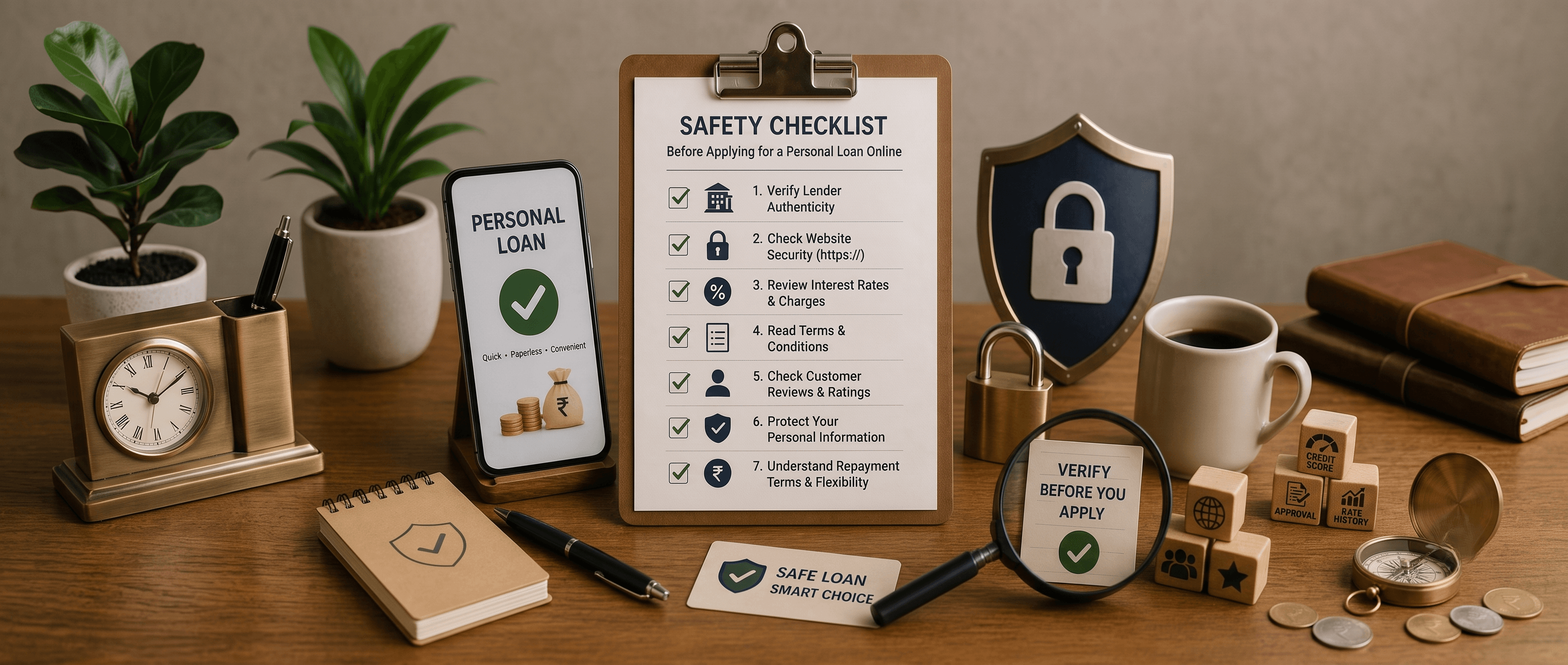
Table of content
Know What to Verify Before Sharing Your Personal Information.
What Is a Digital Personal Loan, and How Does It Work?
Digital Personal Loan Safety Checklist: 7 Things to Verify
How to Submit an Instant Loan Application Securely?
What Should You Do If a Personal Loan App Appears Suspicious?
How Can You Get an Instant Digital Loan With Money in Bank Within Minutes?
Conclusion
Frequently Asked Questions
A digital personal loan can land in your bank account the same day you apply, but that speed is exactly what scammers exploit too. Before you hand over your Aadhaar, PAN, and bank details to any app, there are seven things worth checking first.
Skip them, and you could end up paying hidden charges, or worse, handing your data to a fraudulent lender with no RBI oversight at all.
This isn't a "read the terms and conditions" lecture. It's a practical walkthrough of what to actually look for. By the end, you'll know exactly what to check before your next instant loan application and what to do if something feels off.
Explore the warning signs that separate a genuine lender from a scam dressed up as one.
Follow our Whatsapp Community for more offers and updates.
Join nowA digital personal loan is an unsecured loan you apply for, get approved for, and receive entirely online. The entire loan cycle, including application, verification, disbursal, and repayment tracking, happens inside the app.
For that, you need to download a personal loan app, upload your KYC documents, and wait for approval. The instant loan apps allow you to check approval status instantly. If approved, the amount gets disbursed straight to your bank account, often within hours.
The lender's system checks your income and repayment history using bank statement analysis or alternative data (SMS-based spending patterns, for instance) instead of relying solely on a credit bureau score.
Thus, they have made personal loans more accessible to individuals turned down by traditional lenders only because they lack a high CIBIL score, a long credit history, or rigid income-proof documents.
Before you tap "Apply," run through these seven checks. Missing even one raises your risk of fraud, data misuse, or a loan that costs far more than advertised.
Here's the thing nobody tells you upfront: the app on your phone isn't actually the one lending you money. Behind every genuine digital personal loan sits a bank or an RBI-registered NBFC, and the app is just the storefront.
So dig a little before you dig into your KYC. Scroll to the "About Us" section or footer of the app and look for the NBFC's name, its Certificate of Registration number, and its CIN. Got that? Now cross-check it on the RBI's website, where the full list of registered NBFCs is public. Can't find a lending partner named anywhere, or the name simply isn't on that RBI list? Don't trust the app. Full stop.
Not sure where to start looking? Here's a breakdown of the most trusted instant loan apps in India.
Skip the random links floating around WhatsApp or SMS. Get the app from Google Play or the Apple App Store only, and before you install anything, match the developer's name against what's listed on the lender's own website.
Fake apps mimicking real lenders have shown up on third-party app stores and even briefly on official ones. Match the developer name, publisher details, and app icon with what's listed on the lender's verified website, not just what shows up in a search result.
The advertised rate sometimes doesn’t include the full cost. Sometimes it excludes processing fees, GST, penal charges, and prepayment charges, all of which add up on top of the base rate.
Personal loan interest rates for unsecured, low-documentation loans typically run higher than secured loans, since the lender is taking on more risk without collateral. Ask for (or calculate) the effective APR, not just the monthly rate, before you decide the loan amount actually makes sense for you.
Think about what a personal loan app actually needs to do its job. A few documents for KYC verification, a bank statement or two, or maybe your contact number. That's it. It has no business asking for your entire phone.
If an app wants your contact list, your call logs, or your photo gallery and can't explain why any of that matters for processing a loan, that's a problem. A lender with nothing to hide will publish a privacy policy that tells you plainly what data gets collected, why, and for how long it sticks around. Read that part before you tap accept.
Legitimate lenders keep it simple: standard KYC, proof of income, nothing that feels like overreach or has no bearing on your loan eligibility. So what should you actually expect? The documents required for personal loan usually come down to:
Anything beyond this list, especially stuff that has nothing to do with confirming who you are or what you earn, should raise an eyebrow.
Before applying, check the EMI schedule, the grace period on missed payments, and whether you can foreclose the loan without excessive penalty.
Genuine lenders publish clear repayment terms and offer functioning in-app or phone customer support. If you can't find a working support number, a grievance email, or an escalation process anywhere in the app, walk away; that absence usually isn't an oversight.
Common warning signs of a scam personal loan app include: upfront "advance fee" demands before disbursal, no fixed office address, aggressive recovery agents contacting your personal contacts, and approval that comes with zero income or document verification. A real lender verifies you before lending.
Submit your instant loan application only after confirming the lender's RBI registration, using the official app, and reading the loan agreement in full before accepting it.
A few practical habits make this easier:
Stop the application immediately, don't share further documents, and report the app to Google Play, the Cyber Crime portal (cybercrime.gov.in), or your bank if money has already changed hands.
If you've already paid an "advance fee" or shared KYC documents, change your account passwords, alert your bank about potential fraud, and file a complaint with the RBI's Sachet portal, which tracks unauthorised digital lending complaints. Keep screenshots of the app, chats, and any payment confirmations as evidence.
Fast disbursal depends on three things: an NBFC that assesses income without demanding a high credit score, a fully digital KYC process, and pre-linked bank account verification.
Most instant loan apps that disburse quickly process the loan application in the almost same way. The first step is Aadhaar-based e-KYC; next, income verification through bank statements or salary data, and assessment of the credit bureau report.
Banks usually prefer a 750+ CIBIL score and a long credit history along with a good income source and proper documentation. The digital lenders make loans easily accessible for the gig workers, freelancers, and self-employed applicants with alternative data scoring.
Instead of solely relying on credit reports, they assess banks' statements or UPI transactions to assess cash flow. Basically, they check if you have the potential to repay the loan amount within tenure.
mPokket, for instance, approves loans within a few minutes and disburses funds within an hour. However, they simplify the application and documentation process and speed up approval and disbursal, but every application still goes through eligibility and document checks.
Read to know more about - How does mPokket evaluates personal loan eligibility for the self-employed.
A digital personal loan is only as safe as the lender behind it, and that one fact: verify the NBFC before you verify anything else and decide whether the rest of this checklist even matters. Before your next instant loan application, open the app you're considering right now, find its NBFC registration number, and check it against the RBI's NBFC list. That five-minute step tells you more than any review or rating ever will.
1. What documents are required for a digital personal loan application?
Most lenders ask for Aadhaar, PAN, a selfie, active bank account details, and income proof such as a salary slip or bank statement. Self-employed and gig-income applicants may submit bank statements in place of a salary slip.
2. Do instant loan applications guarantee approval?
No. Instant loan applications still go through eligibility checks. The lenders usually verify income, validate KYC, and assess internal risk. They approve loans instantly with minimal documentation, but approval for any loan application is not guaranteed.
3. How can I check whether a digital personal loan is genuine?
Look up the lender's NBFC name and Certificate of Registration number on the RBI's official NBFC list, confirm the app is downloaded from an official app store, and read the privacy policy and repayment terms before applying.
4. What are the risks of applying for a personal loan through an unknown app?
Risks include data misuse, hidden charges beyond the advertised personal loan interest rates, harassment from unauthorized recovery practices, and, in some cases, upfront fee scams where no loan is ever disbursed.
What Precautions Should You Take Before Choosing an Instant Loan App?
2 min read • 9 July 2025
How mPokket Ensures Data Security Against Identity Theft?
2 min read • 6 December 2024
How Do RBI Regulations Affect Instant Loan Apps in India?
2 min read • 12 May 2025
What Safety Tips Should You Follow When Using Instant Loan Apps?
2 min read • 16 December 2024
Ensuring Safety: A Guide to Recognizing the Security of Instant Loan Apps
7 min read • 17 March 2025